Disruptive selection is natural selection that favours individuals at both extremes of the range and selects against individuals with intermediate phenotypes near the mean.It happens when the environment offers two different conditions or resources, each best exploited by a different extreme phenotype, and intermediate individuals do less well with both.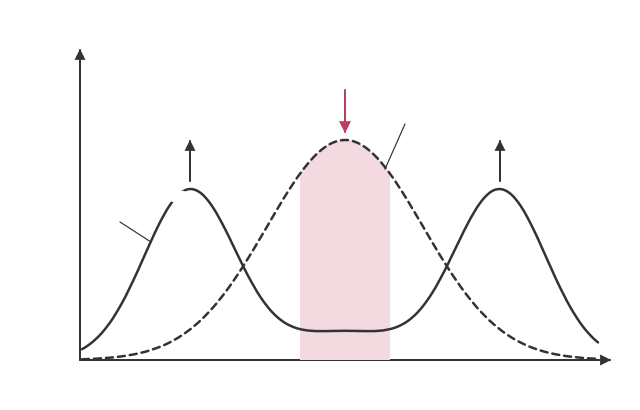
- the distribution becomes bimodal, with two peaks, one towards each extreme;
- the variation in the population increases.Example: the black-bellied seedcracker. This African finch feeds on the seeds of two kinds of sedge, one with hard seeds and one with soft seeds. Birds with large beaks crack the hard seeds efficiently, and birds with small beaks handle the soft seeds efficiently. Birds with intermediate beaks are poor at both, so they are selected against, and the population has two main beak sizes.Disruptive selection is the least common type of selection, but it is important because it can split one population into two groups. If the two groups also stop interbreeding (for example, if individuals mate only with others of the same form), gene flow between them falls and they may eventually become separate species. This is one route to sympatric speciation.