Embryonic stem cells are taken from the inner cell mass of a blastocyst, an early embryo about 5 days after fertilisation. At this stage the embryo is a hollow ball of only around 100 cells.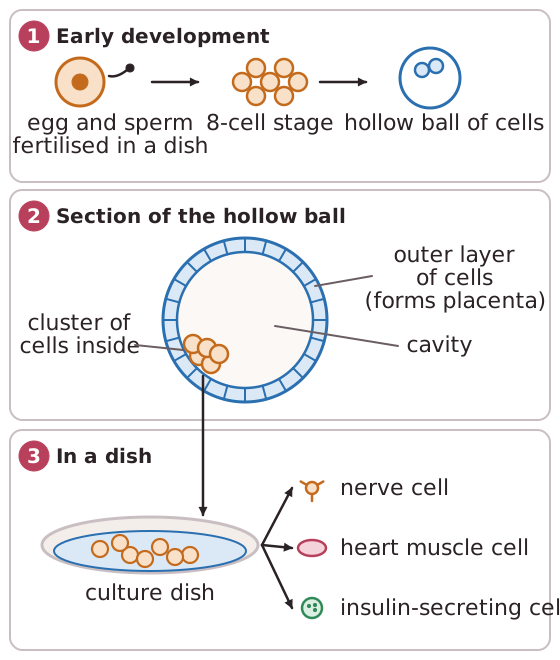 Properties
• They are pluripotent, so they can become any cell type of the body.
• They can divide indefinitely in culture, giving a large supply of cells.Sources
• Spare embryos from IVF treatment, donated with the parents' consent.
• Embryos made by therapeutic cloning, which are genetically matched to a patient.Disadvantages
• Cells from a spare IVF embryo are not genetically identical to the patient, so tissue made from them may be rejected.
• Undifferentiated cells can form teratomas if transplanted.
• Removing the inner cell mass destroys the embryo.Views on using embryos
People who oppose the research argue that the embryo is a potential human being with a right to life, and that it cannot give consent. People who support it argue that:
• an embryo this early has no nervous system, so it cannot feel pain or be aware
• many spare IVF embryos would be discarded anyway
• in natural reproduction, many early embryos fail to implant and are lost.These arguments explain why many countries allow the research only under strict licensing, while others ban it. The ethical problems have driven the search for alternatives, such as adult stem cells and induced pluripotent stem cells.
Properties• They are pluripotent, so they can become any cell type of the body.
• They can divide indefinitely in culture, giving a large supply of cells.Sources
• Spare embryos from IVF treatment, donated with the parents' consent.
• Embryos made by therapeutic cloning, which are genetically matched to a patient.Disadvantages
• Cells from a spare IVF embryo are not genetically identical to the patient, so tissue made from them may be rejected.
• Undifferentiated cells can form teratomas if transplanted.
• Removing the inner cell mass destroys the embryo.Views on using embryos
People who oppose the research argue that the embryo is a potential human being with a right to life, and that it cannot give consent. People who support it argue that:
• an embryo this early has no nervous system, so it cannot feel pain or be aware
• many spare IVF embryos would be discarded anyway
• in natural reproduction, many early embryos fail to implant and are lost.These arguments explain why many countries allow the research only under strict licensing, while others ban it. The ethical problems have driven the search for alternatives, such as adult stem cells and induced pluripotent stem cells.