Therapeutic cloning (somatic cell nuclear transfer) avoids one major problem of embryonic stem cells from IVF embryos: because the nucleus comes from the patient, the cells are genetically matched to the patient and should not be rejected. However, it raises its own scientific and ethical issues.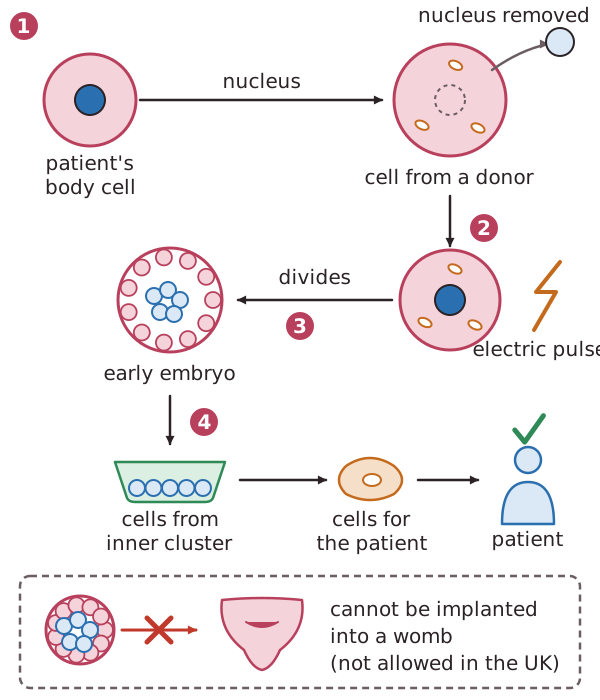 Creating an embryo to destroy it
In therapeutic cloning an embryo is created specifically so that its stem cells can be harvested, and it is destroyed in the process. For people who give the embryo full moral status this is worse than using spare IVF embryos that would be discarded anyway.The need for eggs
Each attempt needs human egg cells, and the process is inefficient, so many eggs are needed. Women donating eggs take hormones to make several eggs mature at once, which carries a risk of ovarian hyperstimulation syndrome. Paying for eggs could put pressure on poorer women.Not a perfect match
The cells are not completely identical to the patient, because their mitochondrial DNA comes from the egg donor. This rarely causes rejection, but it is a genetic difference.Link to reproductive cloning
The same technique produced Dolly the sheep. Implanting a cloned human embryo into a uterus would be reproductive cloning, which is illegal in the UK. Critics fear that perfecting therapeutic cloning makes reproductive cloning easier.Human embryonic stem cells were first made by this method in 2013, but induced pluripotent stem cells now offer a simpler route to patient-matched cells.
Creating an embryo to destroy itIn therapeutic cloning an embryo is created specifically so that its stem cells can be harvested, and it is destroyed in the process. For people who give the embryo full moral status this is worse than using spare IVF embryos that would be discarded anyway.The need for eggs
Each attempt needs human egg cells, and the process is inefficient, so many eggs are needed. Women donating eggs take hormones to make several eggs mature at once, which carries a risk of ovarian hyperstimulation syndrome. Paying for eggs could put pressure on poorer women.Not a perfect match
The cells are not completely identical to the patient, because their mitochondrial DNA comes from the egg donor. This rarely causes rejection, but it is a genetic difference.Link to reproductive cloning
The same technique produced Dolly the sheep. Implanting a cloned human embryo into a uterus would be reproductive cloning, which is illegal in the UK. Critics fear that perfecting therapeutic cloning makes reproductive cloning easier.Human embryonic stem cells were first made by this method in 2013, but induced pluripotent stem cells now offer a simpler route to patient-matched cells.