There are three types of neurones: 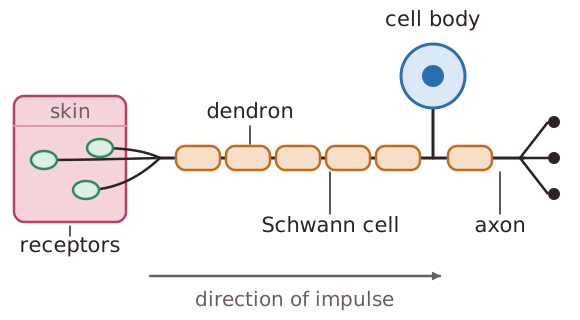 Dendrons are extensions of the cell body which branch into smaller fibres called dendrites. Dendrites carry nerve impulses towards the cell body.Axons are a single long fibre that carry impulses away from the cell body.Schwann cells are cells that wrap around the axon to provide electrical insulation. Layers of membrane containing a fatty substance called myelin provide the electrical insulation. Schwann cells also carry out phagocytosis of cell debris and are involved in nerve regeneration.The nodes of Ranvier occur between Schwann cells every 1-3mm in humans and are about 2-3μm long.
- sensory neurones
- motor neurones
- relay neurones
Dendrons are extensions of the cell body which branch into smaller fibres called dendrites. Dendrites carry nerve impulses towards the cell body.Axons are a single long fibre that carry impulses away from the cell body.Schwann cells are cells that wrap around the axon to provide electrical insulation. Layers of membrane containing a fatty substance called myelin provide the electrical insulation. Schwann cells also carry out phagocytosis of cell debris and are involved in nerve regeneration.The nodes of Ranvier occur between Schwann cells every 1-3mm in humans and are about 2-3μm long.