Skip to content

Muscle Fibres

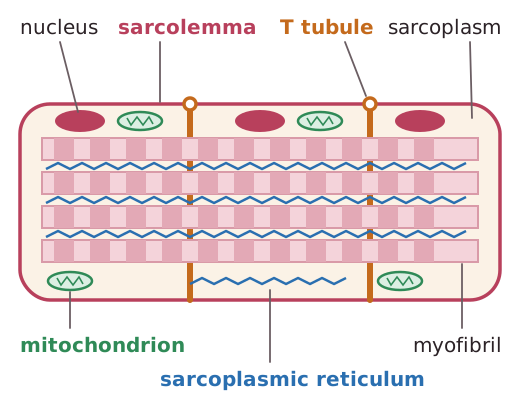
Skeletal muscles are specialised cells made up of bundles of long, tubular, multinucleate cells called muscle fibres. The muscle fibres are covered by a plasma membrane called the sarcolemma. The cytoplasm is known as the sarcoplasm and contains lots of mitochondria to produce ATP for muscle contraction. They have specialised endoplasmic reticulum called the sarcoplasmic reticulum and the sarcolemma is folded inwards to form transverse or T tubules.
Read the text

Read the text and highlight anything you think is important. When you go on, the text is hidden and you answer from memory.

Specification: AQA Biology (7402), A-level, 3.6.3 Skeletal muscles are stimulated to contract by nerves and act as. Topic: Muscles.

Key terms in this lesson

glycolysis
The first stage of respiration, occurring in the cytoplasm, in which glucose is split into two molecules of pyruvate with a net yield of 2 ATP and reduced NAD.
pyruvate
The three-carbon end product of glycolysis, which enters the mitochondrion for the link reaction in the presence of oxygen or is reduced to lactate or ethanol in its absence.
electron transport chain
A series of protein complexes in the inner mitochondrial (or thylakoid) membrane that pass electrons along a chain of redox reactions, pumping protons across the membrane to generate a proton gradient.
ATP
Adenosine triphosphate, the universal energy currency of cells, formed by adding an inorganic phosphate to ADP and hydrolysed to release energy for cellular reactions.

More in Muscles

All 15 lessons in Muscles · All AQA A-level Biology topics