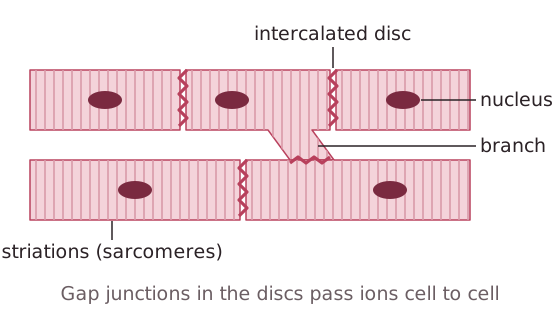
Cardiac muscle is found only in the walls of the heart. It is involuntary, which means it is not under conscious control, and it is myogenic: it contracts and relaxes rhythmically without needing stimulation from nerves. Each heartbeat is started by the sinoatrial node (SAN), a patch of specialised tissue in the wall of the right atrium.Cardiac muscle cells are branched and interconnected. Each cell usually has one nucleus and shows faint cross-striations, because it contains actin and myosin filaments arranged in sarcomeres, as in skeletal muscle.Neighbouring cells are joined end to end by intercalated discs. These contain gap junctions that let ions pass freely from cell to cell, so waves of electrical excitation spread quickly and the muscle contracts in a coordinated way.The speed and duration of contraction are intermediate between skeletal and smooth muscle. Cardiac muscle has many mitochondria and a rich blood supply, so it respires aerobically all the time and does not fatigue.Although the heart is myogenic, its rate can be changed by the cardiovascular centre in the medulla oblongata, through the autonomic nervous system.