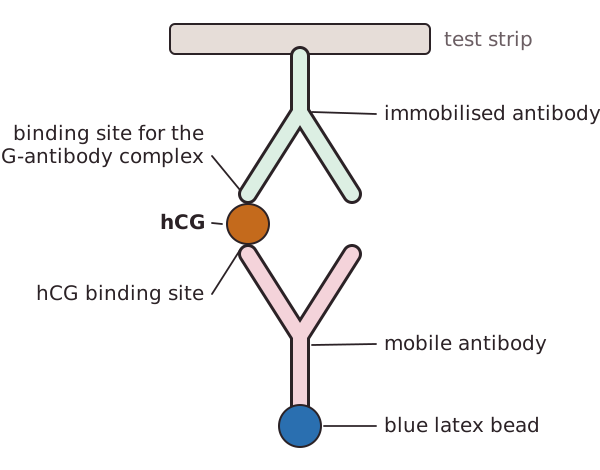
Once the human embryo has been fertilised, it becomes implanted into the uterus. At this stage the embryo secretes a hormone called human chorionic gonadotrophin (hCG). hCG is a small glycoprotein of molecular mass 36,700 and can be found in the urine a few days after conception.A pregnancy test consists of monoclonal antibodies for hCG tagged with blue latex beads and a strip of immobilised anti-hCG antibodies that will bind to hCG-antibody complexes. The pregnancy test strip is dipped in urine. If hCG is present, it will bind to the monoclonal antibodies and move up the strip where it will be immobilised and form a blue line.