 BRAINCAKE
ADH
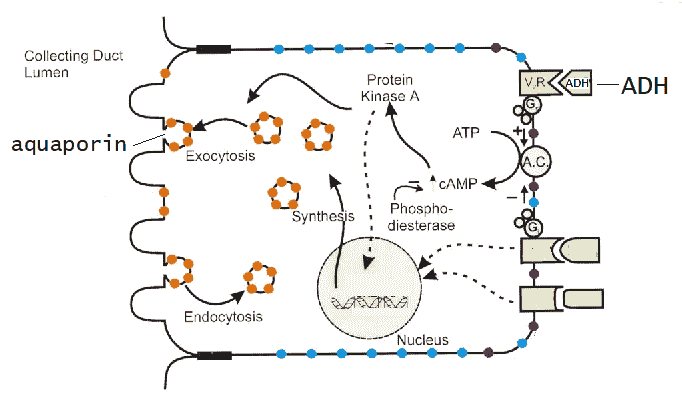
Osmoreceptors in the hypothalamus monitor the water potential of the blood. When the water potential is low, the cells shrink and stimulate neurosecretory cells to produce ADH. ADH flows down the axon to the posterior pituitary where it is stored. When the neurosecretory cells are stimulated they send impulses to the pituitary which releases ADH into the blood. ADH is broken down slowly by enzymes and has a half-life of 20 minutes.
Sign in free to see the rest of this lesson, the R.E.C.I.P.E. recall steps and the quiz
BrainCake is free. Make an account in seconds and pick up where this page stops.
Key terms in this lesson
- hypothalamus
- A region of the brain containing centres that monitor and regulate core body temperature and water potential, among other homeostatic functions.
More in Homeostasis
- Loop of Henlé
- Countercurrent Multiplier
- Ultrafiltration, Selective Reabsorption and Osmoregulation.
- Distal Tubule and Collecting Duct
- Kidney failure
- Haemodialysis
- Peritoneal Dialysis
- Pregnancy Testing
All 33 lessons in Homeostasis · All AQA A-level Biology topics