 BRAINCAKE
Distal Tubule and Collecting Duct
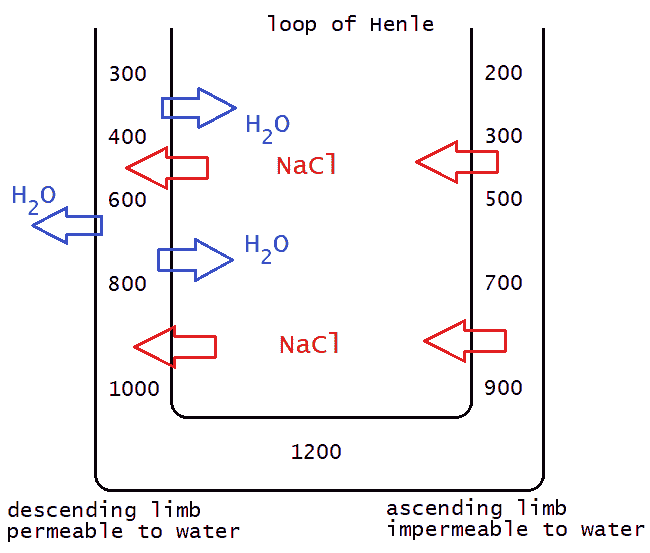
Fluid passes from the top of the ascending limb of loop of Henlé to a short distal convoluted tubule. Active transport is used to adjust the concentration of various salts. The collecting duct carries the fluid through the medulla to the pelvis. The tissue fluid in the medulla has a low water potential so water moves out of the collecting ducts by osmosis.
Sign in free to see the rest of this lesson, the R.E.C.I.P.E. recall steps and the quiz
BrainCake is free. Make an account in seconds and pick up where this page stops.
Key terms in this lesson
- loop of Henle
- The region of a nephron between the proximal and distal convoluted tubules that creates a concentration gradient in the medulla, enabling the reabsorption of water.
- ADH
- Antidiuretic hormone, released by the posterior pituitary gland in response to a fall in blood water potential, which increases the permeability of the collecting duct to water by inserting aquaporins.
More in Homeostasis
- Proximal Convoluted Tubule
- Loop of Henlé
- Countercurrent Multiplier
- Ultrafiltration, Selective Reabsorption and Osmoregulation.
- ADH
- Kidney failure
- Haemodialysis
- Peritoneal Dialysis
All 33 lessons in Homeostasis · All AQA A-level Biology topics