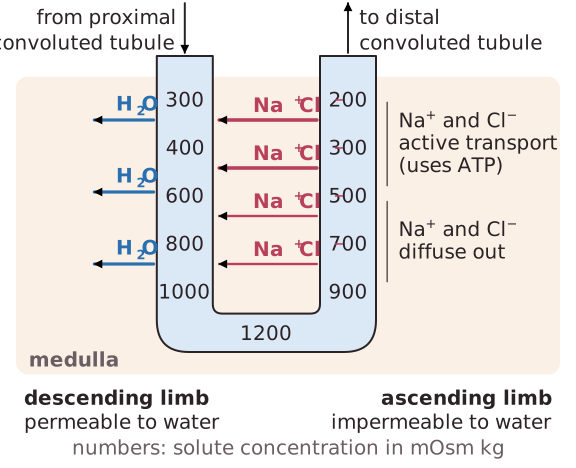
At the top of the ascending loop of Henlé sodium and chloride ions are actively transported out of the Loop of Henlé into the interstitial tissue fluid. This creates a high salt concentration in the medulla. Sodium and chloride ions diffuse into the descending limb and water moves out of the descending limb by osmosis.At the base of the loop of Henlé and as the fluid moved up the ascending limb sodium and chloride ions diffuse out into the tissue fluid, but water cannot move in or out as the ascending limb is impermeable to water. The result is the movement of salts into the tissue fluid from the ascending limb, creating a low water potential in the medulla drives the reabsorption of water by osmosis from the descending limb.