Most genes you meet first show dominance: in a heterozygote, only the dominant allele is expressed in the phenotype. Some genes behave differently.Codominance occurs when both alleles of a gene are expressed in the phenotype of a heterozygote. Neither allele is recessive, so the heterozygote has a third, distinct phenotype.Because neither allele is dominant, codominant alleles are not shown with a capital and a lower-case letter. Instead, a letter represents the gene and a superscript represents each allele.Example 1: coat colour in shorthorn cattle
CRCR = red coat
CWCW = white coat
CRCW = roan coat, a mixture of red hairs and white hairsThe roan animal is not a blend: it has both red and white hairs, showing that both alleles are expressed.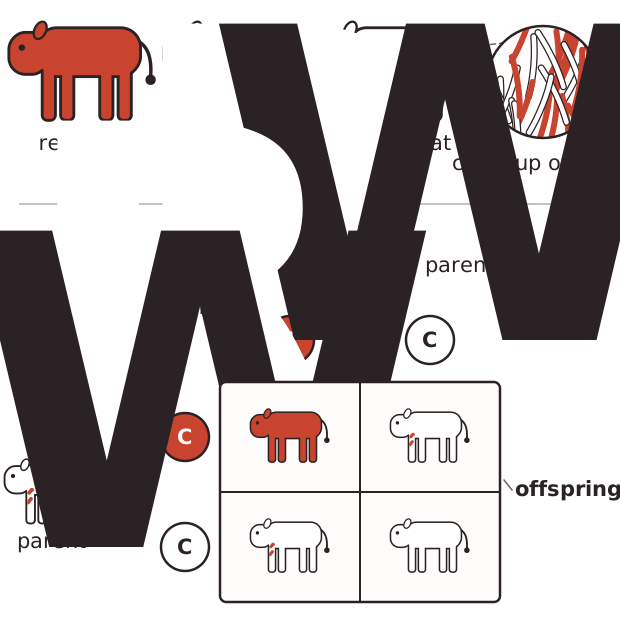 Example 2: sickle cell anaemia
The gene for the β-polypeptide of haemoglobin has alleles HbA (normal) and HbS (sickle). A person who is HbAHbS makes both normal and sickle haemoglobin. They have sickle cell trait: usually healthy, but some red blood cells may sickle when oxygen is low.A useful consequence of codominance is that each genotype produces a different phenotype. You can therefore work out an individual's genotype directly from its phenotype, which is not possible for a dominant phenotype under ordinary dominance.
CRCR = red coat
CWCW = white coat
CRCW = roan coat, a mixture of red hairs and white hairsThe roan animal is not a blend: it has both red and white hairs, showing that both alleles are expressed.
Example 2: sickle cell anaemiaThe gene for the β-polypeptide of haemoglobin has alleles HbA (normal) and HbS (sickle). A person who is HbAHbS makes both normal and sickle haemoglobin. They have sickle cell trait: usually healthy, but some red blood cells may sickle when oxygen is low.A useful consequence of codominance is that each genotype produces a different phenotype. You can therefore work out an individual's genotype directly from its phenotype, which is not possible for a dominant phenotype under ordinary dominance.