An autosome is any chromosome that is not a sex chromosome. Two genes are autosomally linked when their loci are on the same autosome.Linked genes do not assort independently in meiosis. Their alleles tend to be inherited together, because they are carried on the same chromosome into the same gamete. As a result, a dihybrid cross involving linked genes does not give the expected 9 : 3 : 3 : 1 (or 1 : 1 : 1 : 1 in a test cross). Instead, most offspring have the same combinations of alleles as the parents.Linked alleles can be separated by crossing over, when non-sister chromatids of homologous chromosomes exchange sections during prophase I of meiosis. Gametes with new combinations of alleles are produced, and offspring that inherit them are called recombinant offspring. Recombinants are fewer than parental types.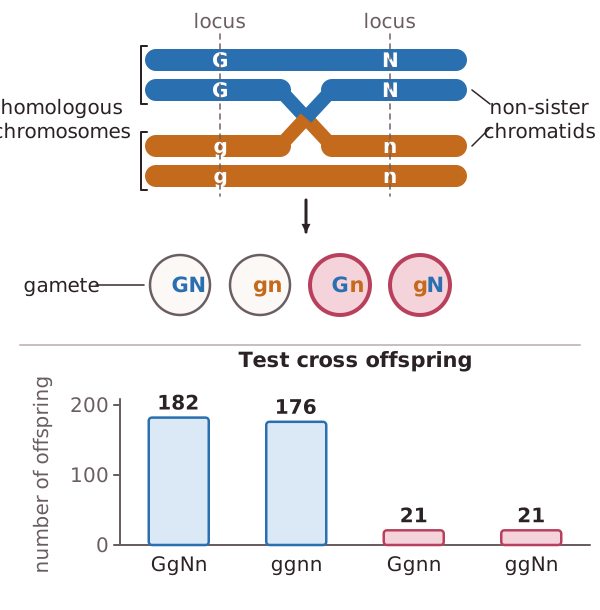 The closer together two loci are, the less likely a crossover is to happen between them, so the fewer recombinants there are.Worked example
A fruit fly heterozygous for two linked genes, with alleles G and N on one chromosome and g and n on the other, is crossed with a ggnn fly. The offspring are: GgNn 182, ggnn 176, Ggnn 21, ggNn 21.The recombinants are Ggnn and ggNn, the two smallest classes:recombination frequency = (21 + 21) ÷ 400 × 100 = 10.5% A low recombination frequency shows the loci are close together on the chromosome.
The closer together two loci are, the less likely a crossover is to happen between them, so the fewer recombinants there are.Worked exampleA fruit fly heterozygous for two linked genes, with alleles G and N on one chromosome and g and n on the other, is crossed with a ggnn fly. The offspring are: GgNn 182, ggnn 176, Ggnn 21, ggNn 21.The recombinants are Ggnn and ggNn, the two smallest classes: