Consumers also lose much of the chemical energy they take in. Their net production (the energy stored in their new biomass) is calculated from:N = I − (F + R) where:
• N is the net production of the consumer;
• I is the chemical energy store in ingested food;
• F is the chemical energy lost to the environment in faeces and urine;
• R is the respiratory losses to the environment.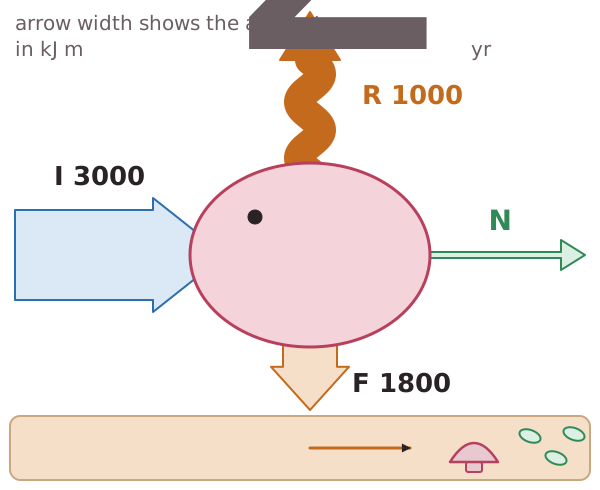 Faeces contain undigested food, such as cellulose that herbivores cannot fully digest. Urine contains waste such as urea. The energy in F is not lost from the ecosystem: it is available to decomposers.N is the energy available for the consumer's growth and reproduction, and for the next trophic level.Worked example: A population of cattle ingests 3000 kJ m−2 yr−1. It loses 1800 kJ m−2 yr−1 in faeces and urine and 1000 kJ m−2 yr−1 in respiration.
N = 3000 − (1800 + 1000) = 200 kJ m−2 yr−1.Add F and R before subtracting from I.A smaller proportion of I becomes N in endotherms (birds and mammals) than in ectotherms, because endotherms use a lot of energy in respiration to keep their body temperature constant. The proportion is also usually smaller in herbivores than in carnivores, because plant material is harder to digest, so F is larger.
• N is the net production of the consumer;
• I is the chemical energy store in ingested food;
• F is the chemical energy lost to the environment in faeces and urine;
• R is the respiratory losses to the environment.
Faeces contain undigested food, such as cellulose that herbivores cannot fully digest. Urine contains waste such as urea. The energy in F is not lost from the ecosystem: it is available to decomposers.N is the energy available for the consumer's growth and reproduction, and for the next trophic level.Worked example: A population of cattle ingests 3000 kJ m−2 yr−1. It loses 1800 kJ m−2 yr−1 in faeces and urine and 1000 kJ m−2 yr−1 in respiration.N = 3000 − (1800 + 1000) = 200 kJ m−2 yr−1.Add F and R before subtracting from I.A smaller proportion of I becomes N in endotherms (birds and mammals) than in ectotherms, because endotherms use a lot of energy in respiration to keep their body temperature constant. The proportion is also usually smaller in herbivores than in carnivores, because plant material is harder to digest, so F is larger.