The chemical energy stored in dry biomass can be estimated using calorimetry. A bomb calorimeter gives the most accurate results.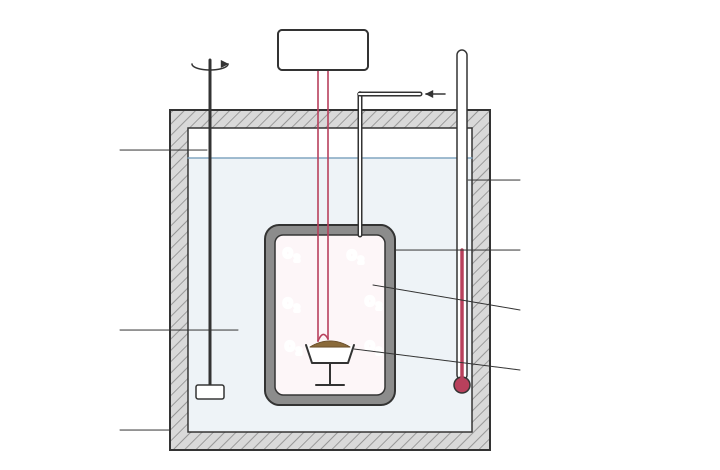
energy = m × c × ΔT where m is the mass of water (g), c is the specific heat capacity of water (4.18 J g−1 °C−1) and ΔT is the temperature rise (°C). Dividing by the mass of biomass burned gives the energy per gram.Worked example: Burning 1.0 g of dry plant material raises the temperature of 1000 g of water by 4.0 °C.
Energy = 1000 × 4.18 × 4.0 = 16 720 J = 16.7 kJ, so the biomass stores 16.7 kJ g−1.Dry biomass is used because water in the sample would absorb energy. Pure oxygen ensures complete combustion, and the insulation reduces energy lost to the surroundings. A simple calorimeter, where a sample burns in air under a tube of water, gives lower values because much energy is lost and combustion may be incomplete.Multiplying the energy per gram by the biomass per unit area gives the chemical energy store per unit area, in kJ m−2.
Energy = 1000 × 4.18 × 4.0 = 16 720 J = 16.7 kJ, so the biomass stores 16.7 kJ g−1.Dry biomass is used because water in the sample would absorb energy. Pure oxygen ensures complete combustion, and the insulation reduces energy lost to the surroundings. A simple calorimeter, where a sample burns in air under a tube of water, gives lower values because much energy is lost and combustion may be incomplete.Multiplying the energy per gram by the biomass per unit area gives the chemical energy store per unit area, in kJ m−2.