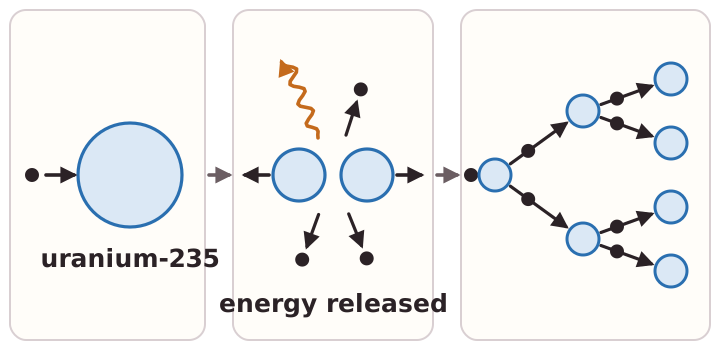
Some large nuclei, such as uranium-235 and plutonium-239, are unstable. In nuclear fission an unstable nucleus splits into two smaller nuclei of similar size. Fission usually happens only when the unstable nucleus first absorbs a neutron. The nucleus then splits, and two or three more neutrons are released, along with gamma radiation.
The two smaller nuclei fly apart at high speed, so they have a lot of kinetic energy. When they collide with other particles, they transfer this energy to them. The particles move faster and the thermal energy of the surroundings increases. In a nuclear power station this heats water to make steam.
The neutrons released can be absorbed by other unstable nuclei. Each of these then splits and releases more neutrons, which cause further fission. This is a chain reaction. If it is not controlled, the energy is released all at once, as in a nuclear weapon. In a reactor, some of the neutrons are absorbed so that the reaction is kept steady.