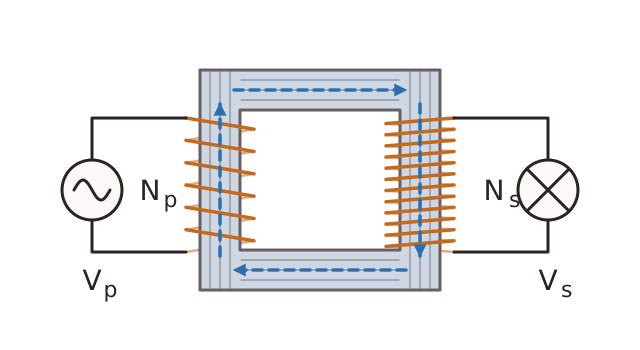
The ratio of the potential differences across the two coils of a transformer is equal to the ratio of the numbers of turns on the coils. As an equation, Vs / Vp = Ns / Np. Here Vp and Vs are the potential differences across the primary and secondary coils, and Np and Ns are the numbers of turns on them.
The same changing magnetic field passes through every turn of the secondary coil, so each turn has the same potential difference induced in it. The turns are in series, so more turns add up to a larger potential difference.
A transformer with more turns on the secondary coil than on the primary coil gives a larger potential difference. It is a step-up transformer. A transformer with fewer turns on the secondary coil gives a lower potential difference. It is a step-down transformer. For example, 100 primary turns and 200 secondary turns give a secondary potential difference twice the primary potential difference.