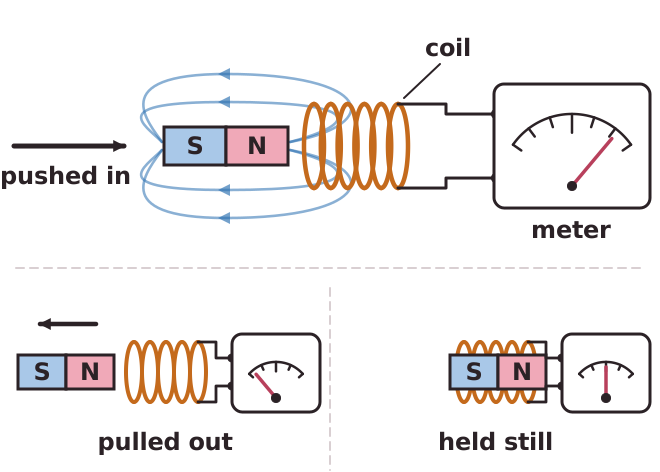
If a conductor and a magnetic field move relative to each other so that the magnetic field around the conductor changes, a potential difference is induced across the ends of the conductor. This is called electromagnetic induction. If the conductor is part of a complete circuit, the induced potential difference drives an induced current.
You can see this by pushing a bar magnet into a coil connected to a sensitive galvanometer. The needle moves while the magnet moves, because the field around the coil changes. It returns to zero when the magnet stops. No change in field means no induced potential difference. Pulling the magnet out makes the needle move the other way.
The induced potential difference increases with a faster movement, a stronger magnet or more turns on the coil. The induced current produces its own magnetic field, and this field always opposes the change that caused it.