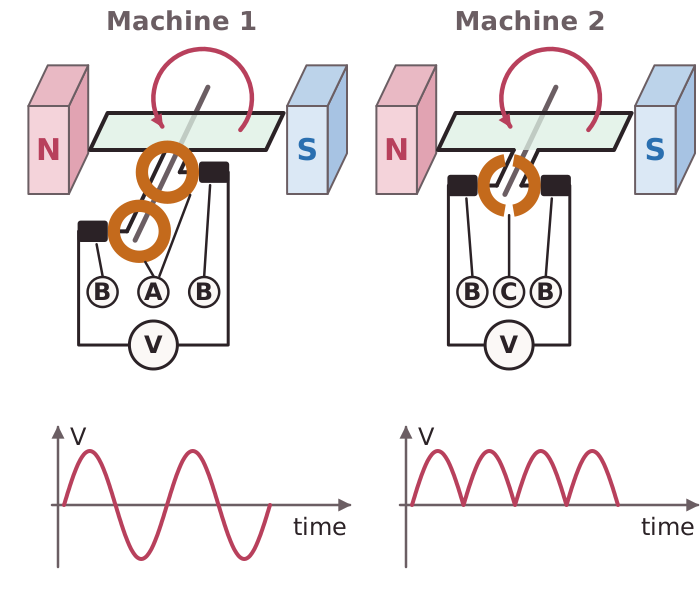
An alternator generates a.c. A coil of wire is turned in a magnetic field, so the field through the coil keeps changing and a potential difference is induced across the coil. The ends of the coil are joined to slip rings, and carbon brushes press against them to connect to the outside circuit. As the coil turns, each side moves up through the field and then down through the field, so the induced potential difference reverses direction every half turn. The output is alternating current (a.c.).
A dynamo has the same basic design, but the slip rings are replaced by a split-ring commutator. It swaps the connections to the outside circuit every half turn, just as the induced potential difference reverses. The current in the outside circuit therefore always flows the same way, which is direct current (d.c.). The size of the d.c. output still rises and falls as the coil turns.
Turning the coil faster, or using a stronger magnet or more turns, increases the induced potential difference. A dynamo is built like a d.c. motor but works in reverse: it is turned to produce a potential difference, instead of being supplied with current to produce rotation.