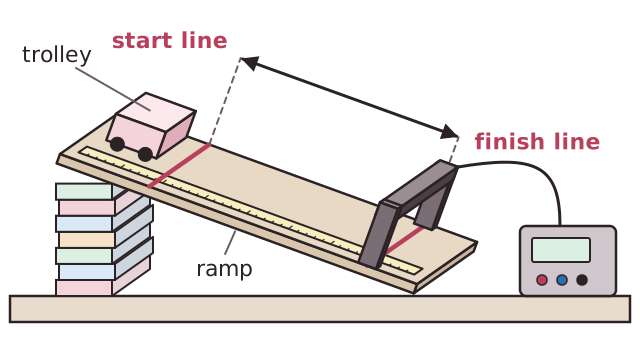
To find how fast something moves we need two measurements: the distance it travels, in metres (m), and the time it takes, in seconds (s).
Short distances, such as the length of a ramp, are measured with a metre rule. Longer distances, such as a running track or a school corridor, are measured with a tape measure or a trundle wheel. The start and finish points are marked before the object moves.
Time is often measured with a stopwatch. A person starts and stops it a fraction of a second late, an error caused by human reaction time, so it suits long times but is poor for very fast motion. For a trolley rolling down a ramp, a light gate connected to a data logger is better. It starts and stops the clock automatically when the trolley breaks the beam, so there is no reaction time.
Whichever method is used, repeat the measurement several times and calculate the mean. This reduces the effect of random errors. Average speed is then found using speed = distance ÷ time. For example, 1.2 m in 2.4 s gives 1.2 ÷ 2.4 = 0.5 m/s.