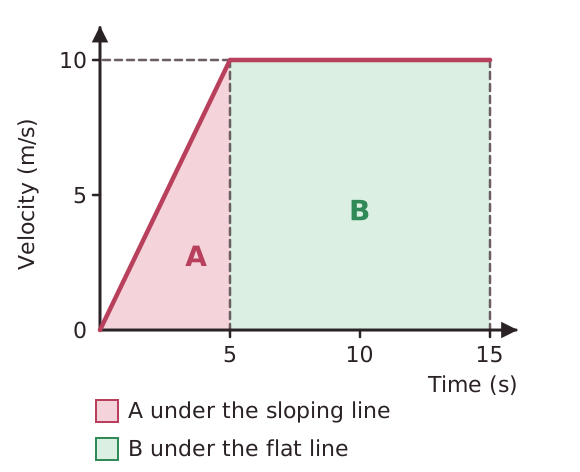
The area enclosed between a velocity-time graph line and the time axis is the distance travelled. This works because velocity × time = distance. The units agree too: metres per second multiplied by seconds gives metres.
For a rectangle, area = height × width, which here is velocity × time. For a triangle, area = ½ × base × height. For a more complex shape, split it into rectangles and triangles, find each area and add them.
Example: an object accelerates uniformly from 0 to 10 m/s in 5 s, then travels at a steady 10 m/s for 10 s. The triangle has area ½ × 5 × 10 = 25 m. The rectangle has area 10 × 10 = 100 m. The total distance travelled is 125 m. A shorter case: a steady 3 m/s for 4 s gives a rectangle of 3 × 4 = 12 m, and a rise from 0 to 4 m/s in 3 s gives a triangle of ½ × 3 × 4 = 6 m.
If the line is curved, the area can be estimated by counting squares on the graph paper. Each square represents a distance, found by multiplying its height by its width on the axes' scales. Counting squares gives an estimate, not an exact value.