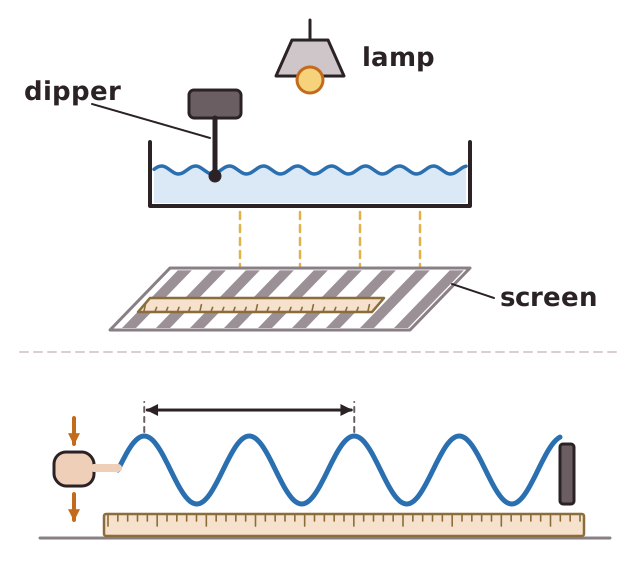
In this practical you decide whether the equipment you have is suitable for measuring the speed, frequency and wavelength of a wave in a solid and in a fluid. You then use v = f × λ, or v = x ÷ t, to find the wave speed.
Fluid: use a ripple tank. A vibrating dipper makes ripples. Measure the distance across several wavefronts on the screen with a ruler and divide by the number of waves to get the wavelength. Find the frequency from the dipper setting, from a stroboscope, or by counting the waves passing a point in a measured time. Solid: stretch a long spring (such as a slinky) along the floor and shake one end up and down at a steady rate. Measure the wavelength with a ruler and count the shakes in a measured time to get the frequency. You can also time one pulse along a measured length to find its speed. Waves on a slinky are slow, typically around 1.0 m/s, so the pulse takes a measurable time.
Judge the equipment. A stopwatch has an error from human reaction time of about 0.2 s, so it is only suitable for timing something over a long time. Fast waves, like ripples, are better recorded on video, which can be slowed down and timed accurately. A ruler measuring across many wavelengths gives a smaller percentage uncertainty than measuring one. Repeat readings and take a mean to improve reliability, and keep the depth of water or the tension of the spring the same.
Example: 30 waves pass a point on a rope in 10 s, so the frequency is 3 Hz. With a wavelength of 0.20 m the speed is 3 × 0.20 = 0.60 m/s.
When sound passes from one medium into another, its frequency stays the same, but its speed and wavelength change together because v = f × λ.