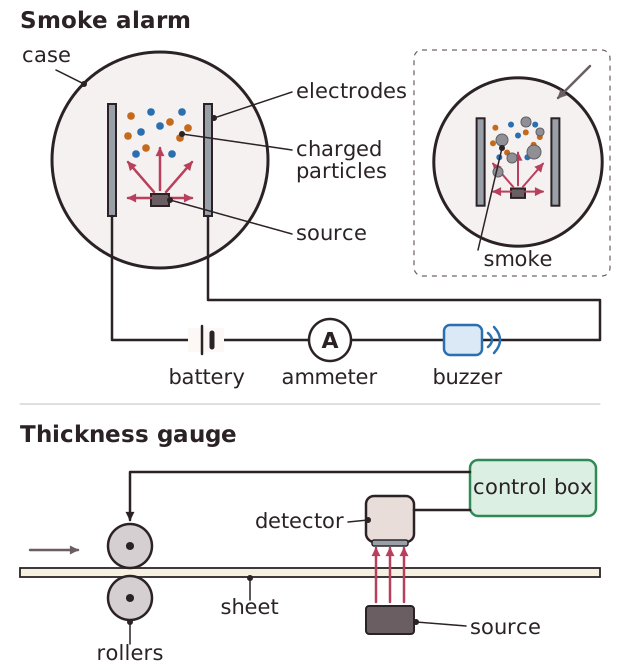
Radioactive sources are useful because their radiation is easy to detect and can kill living cells. A household smoke alarm contains a small source of americium-241, which emits alpha radiation. The alpha particles ionise the air between two electrodes, so a small current flows. When smoke enters, it absorbs the alpha particles, the current falls and the alarm sounds. Alpha is safe here because it cannot get through the case, and the long half-life means the alarm works for years.
Gamma rays are used to kill microbes. In irradiating food, gamma rays kill bacteria and moulds so the food stays fresh for longer. The food does not become radioactive, because the source stays outside it. The same idea is used for sterilisation of equipment: syringes and surgical tools are sealed in their packaging and then irradiated, which kills microbes without the heat that would melt plastic.
In gauging thickness, a beta source is placed on one side of a moving sheet of paper, foil or plastic and a detector on the other. Beta is used because alpha is stopped completely, while gamma passes through almost all of the sheet whatever its thickness. If the count rate rises, the sheet is too thin, and the rollers are adjusted. Tracers are gamma emitters with a short half-life. They are added to a pipe to find a leak, or swallowed or injected so a detector outside the body can follow them and help with diagnosis, while the patient receives only a small dose.
To treat cancer, a narrow beam of gamma rays is aimed at the tumour from several directions to kill cancer cells, or a small source is placed inside the body next to the tumour.