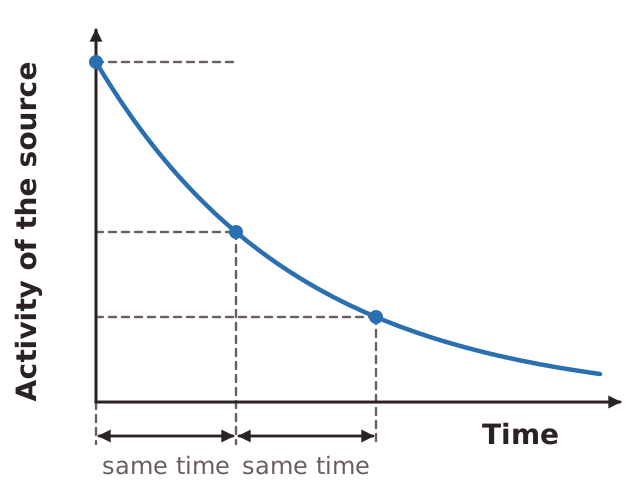
An unstable nucleus decays at random, and the activity of a radioactive source gradually falls as more of its nuclei decay. Activity is measured in becquerel (Bq), where 1 Bq is one decay per second. Each isotope decays at its own steady rate, and we describe that rate using its half-life.
The half-life is the time taken for half of the undecayed nuclei in a sample to decay. It can also be described as the time taken for the activity of a source to fall to half of its starting value. The two descriptions mean the same thing, because the activity is proportional to the number of undecayed nuclei.
For example, an isotope has a half-life of 6 hours and a sample starts with 800 undecayed nuclei. After 6 hours, 400 undecayed nuclei are left and the activity is halved. After another 6 hours, half of those have decayed too, so 200 are left. The nuclei that have decayed have not vanished. They have changed into nuclei of a different element.
Different isotopes have different half-lives, from a tiny fraction of a second to billions of years. A short half-life means the nuclei decay quickly, while a long half-life means the source stays radioactive for a very long time.