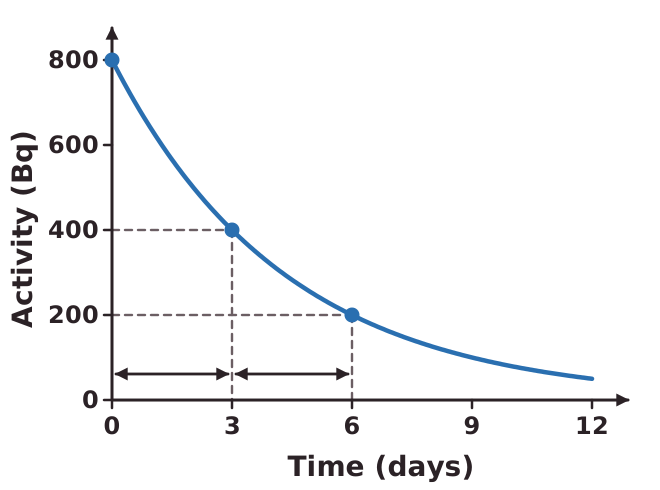
To carry out a half-life calculation, first work out how many half-lives have passed by dividing the total time by the half-life. Then halve the starting activity, or the number of undecayed nuclei, once for each half-life.
Example: a source has an activity of 800 Bq and a half-life of 3 days. 9 days is 3 half-lives. The activity falls from 800 Bq to 400 Bq, then to 200 Bq, then to 100 Bq. After three half-lives, one eighth of the original activity is left.
The fraction left halves each time. After one half-life, 1/2 is left (50%). After two half-lives, 1/4 is left (25%). After three half-lives, 1/8 is left (12.5%). The same rule works for the number of undecayed nuclei.
A graph of activity against time is a curve. It falls steeply at first and then gets flatter, and it never quite reaches zero. To find the half-life from a graph, pick any activity, then read off the time at which the activity has fallen to half of that value. The time difference is the half-life, and it is the same wherever on the curve you start.