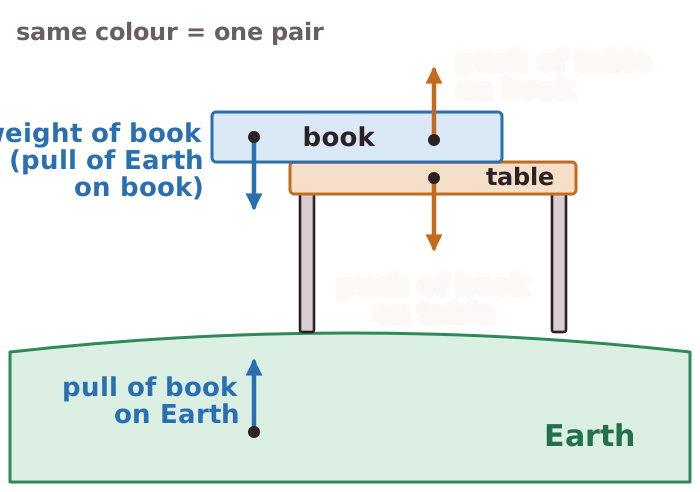
Newton's third law says that when object A exerts a force on object B, object B exerts a force on A that is equal in size and opposite in direction. The two forces in a pair are always the same type of force, for example both gravitational or both contact forces, and they act on different objects. If you push a wall with 80 N, the wall pushes back on you.
Take a book resting on a table, which is in equilibrium. The book's weight pulls it down, and the contact force from the table pushes it up. These two forces are not a third law pair, because they act on the same object and are different types of force. They cancel only because the book is in equilibrium. The partner of the Earth pulling the book down is the book pulling the Earth up with an equal force.
In a collision, the two objects exert equal and opposite forces on each other for the same time. So the momentum gained by one object equals the momentum lost by the other. The total momentum of the objects is therefore conserved, which means it is the same before and after the collision, provided no external forces act.