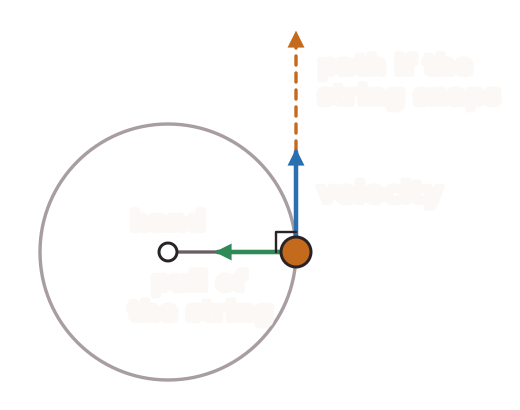
By Newton's first law, an object keeps moving in a straight line at constant speed unless a resultant force acts on it. To make an object follow a circle, there must be a resultant force pulling it towards the centre of the circle. This force is called the centripetal force.
Centripetal force is not a new kind of force. It is the name for the resultant force towards the centre, and it is always provided by a real force. For a planet going round the Sun, or a satellite going round the Earth, it is the gravitational force. For a ball whirled on a string, it is the tension in the string. For a car going round a bend, it is friction between the tyres and the road.
The centripetal force acts at right angles to the direction of motion. It changes the direction of the velocity but does not change the speed, so the speed stays constant while the object keeps accelerating towards the centre. If the force stops, for example when the string snaps, the object moves off in a straight line along the tangent. If the force is too small, as on an icy road, the object cannot follow the circle.