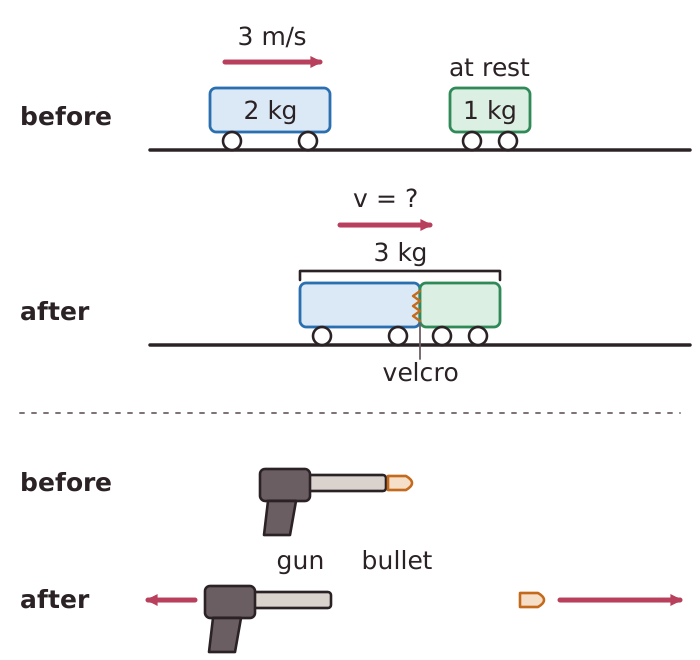
Momentum is mass multiplied by velocity, so it has a direction. In a closed system (one with no external forces such as friction) the total momentum before a collision or explosion is equal to the total momentum after it. This is called conservation of momentum. To add momenta, choose one direction as positive and the opposite direction as negative.
Common examples:
- Trolleys that stick together (an inelastic collision): a 2 kg trolley moving at 3 m/s hits a stationary 1 kg trolley and they join. Momentum before = 2 × 3 = 6 kg m/s. After the collision the 3 kg combined mass moves at v, so 3 × v = 6 and v = 2 m/s. Some kinetic energy is transferred to thermal energy and sound.
- Trolleys that bounce apart using a spring or magnets (a near elastic collision): total momentum is conserved and almost no kinetic energy is lost.
- An explosion or a gun firing: everything starts at rest, so the total momentum before is zero. After firing, the bullet moves forward and the gun recoils backwards with a momentum of the same size, so the total is still zero.
This links to Newton's third law. During a collision the two objects exert equal and opposite forces on each other for the same time, so the momentum one object gains is the momentum the other loses. The total is conserved.