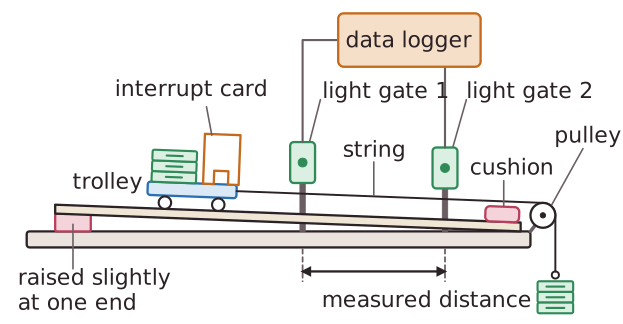
This core practical tests Newton's second law, F = ma. A trolley sits on a runway and is pulled along by a string that runs over a pulley. The other end of the string carries a hanger with slotted masses. The pulling force is the weight of the hanger and its masses, found from W = mg. With g = 10 N/kg, every 0.1 kg of hanging mass gives a force of 1 N. For example, a 0.2 kg hanger gives a force of 2 N, and if the total mass is 0.5 kg the acceleration is 2 ÷ 0.5 = 4 m/s².
Friction would spoil the results, so the runway is tilted slightly until a trolley given a gentle push keeps moving at a steady speed. A card on the trolley passes through a light gate, which gives the velocity from the card length and the time the beam is blocked. Two light gates give the initial velocity u, the final velocity v and the time between them. The acceleration is (v − u) ÷ time.
To investigate mass, keep the force the same by leaving the same masses on the hanger, and add slotted masses to the trolley. Record the acceleration for each total mass. To investigate force, keep the total mass the same by moving slotted masses from the trolley to the hanger one at a time. The force changes but the mass being accelerated does not. Control variables are the runway slope and the distance between the light gates.
The results show that acceleration is directly proportional to force when the mass is constant, so a graph of acceleration against force is a straight line through the origin. Acceleration is inversely proportional to mass when the force is constant, so doubling the mass halves the acceleration and doubling the force doubles it.