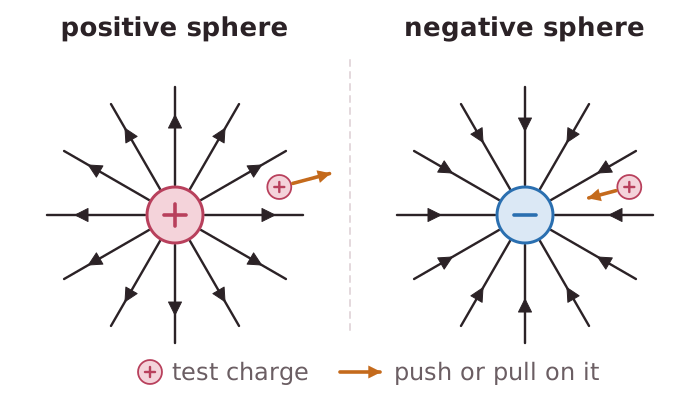
A charged object creates an electric field around itself. This is the region where another charged object feels a force. The field is strongest close to the charged object. The further away from the charged object, the weaker the field.
A second charged object placed in the field experiences a force. The force gets stronger (it increases) as the distance between the objects decreases. The force is a non-contact force, because the second object does not need to be touching the first. The field is what passes the force from one object to the other.
The electric field pattern around an isolated charged sphere is drawn as straight lines spreading out from the centre of the sphere in all directions, like the spokes of a wheel. The arrows on the lines show the direction of the force on a small positive charge. For a positively charged sphere the arrows point away from the sphere. For a negatively charged sphere the arrows point towards it. The lines are closest together near the sphere, where the field is strongest.
Electric fields also help to explain sparking. A charged object has a strong field around it. If the field becomes strong enough, it can pull electrons off atoms in the air, so the air starts to conduct and a spark jumps to a nearby object.