A ripple tank can be used to study water waves.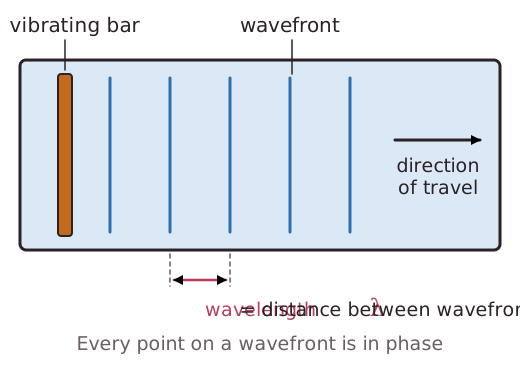 A wave can be represented as a series of wavefronts.A wavefront is a line joining points on a wave which are in phase. The distance between wavefronts is equal to the wavelength of the wave. ReflectionReflection occurs when a wave changes direction at a boundary between two media. The wave remains in the original medium.
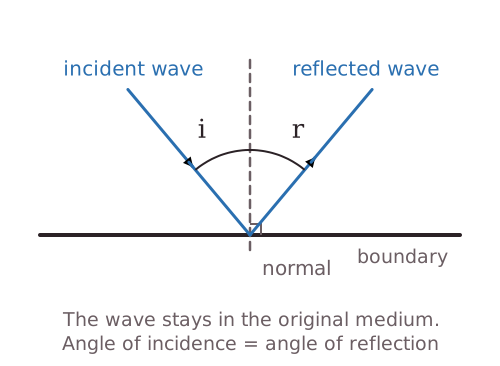 The wavelength and frequency and speed of the wave stay the same. The law of reflection states the angle of incidence = angle of reflectionRefractionRefraction occurs when a wave changes direction at a boundary between two media. The speed of the wave changes as it passes from one medium to another.
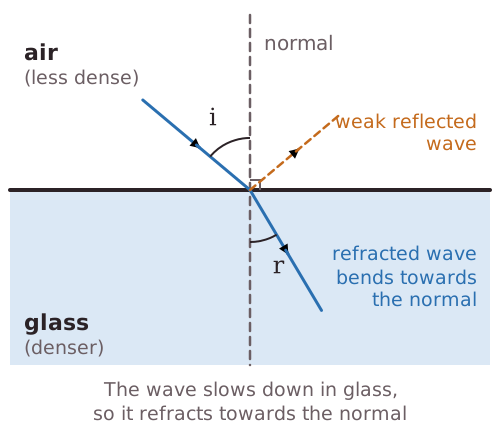 Whenever refraction occurs there is always some partial reflection of the wave. When waves slow down they refract towards the normal. When waves speed up they refract away from the normal.
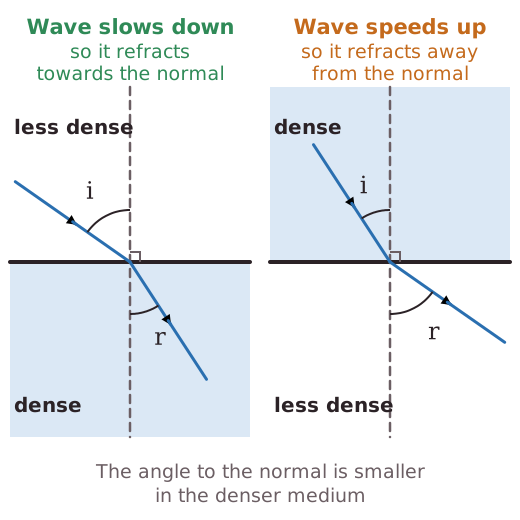 The normal is an imaginary line at 90° to the surface of the plane at which the wave is incident. Sound waves speed up when they enter a denser medium. Electromagnetic waves slow down when they enter a denser medium. Water waves slow down when they enter shallower water and the wavelength gets shorter.
A wave can be represented as a series of wavefronts.A wavefront is a line joining points on a wave which are in phase. The distance between wavefronts is equal to the wavelength of the wave. ReflectionReflection occurs when a wave changes direction at a boundary between two media. The wave remains in the original medium. The wavelength and frequency and speed of the wave stay the same. The law of reflection states the angle of incidence = angle of reflectionRefractionRefraction occurs when a wave changes direction at a boundary between two media. The speed of the wave changes as it passes from one medium to another. Whenever refraction occurs there is always some partial reflection of the wave. When waves slow down they refract towards the normal. When waves speed up they refract away from the normal. The normal is an imaginary line at 90° to the surface of the plane at which the wave is incident. Sound waves speed up when they enter a denser medium. Electromagnetic waves slow down when they enter a denser medium. Water waves slow down when they enter shallower water and the wavelength gets shorter.