Two different types of graph can be used to describe a wave. A displacement-distance graph is also called a wave profile and is a snapshot of the wave at a particular time. It shows the position of all the particles in a wave at one moment in time. A displacement-time graph shows the displacement of a single particle over a period of time. The phase difference of two particles is the fraction of a cycle by which one particle is ahead of or behind the other, along the same or different waves. The phase difference can be measured in degrees or radians.π radians is 180°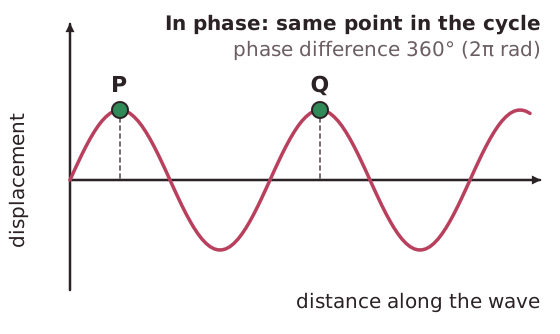 The points P and Q are in phase with each other. They are at the same point in the cycle. They are both at maximum displacement. Their phase difference is therefore 360° or 2π radians.
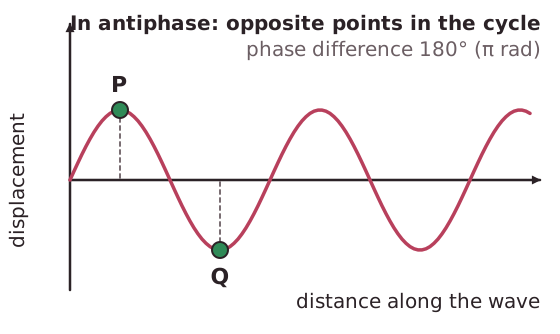 The points P and Q are in antiphase with each other. They are at opposite points in the cycle. They are both at maximum displacement in opposite directions. Their phase difference is therefore 180° or π radians.
The points P and Q are in phase with each other. They are at the same point in the cycle. They are both at maximum displacement. Their phase difference is therefore 360° or 2π radians. The points P and Q are in antiphase with each other. They are at opposite points in the cycle. They are both at maximum displacement in opposite directions. Their phase difference is therefore 180° or π radians.