Electromagnetic Spectrum
Electromagnetic waves are transverse waves. Electromagnetic waves can travel through a vacuum. They can be thought of as electric and magnetic fields oscillating at right angles to each other.
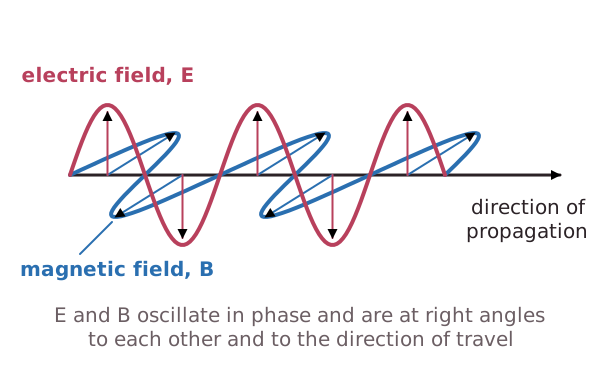
They are classified by their wavelength. All electromagnetic waves have the same speed through a vacuum. The speed of light (EM waves) is c and is equal to 3.0 x 10
8ms
-1. They have different frequencies and wavelengths.
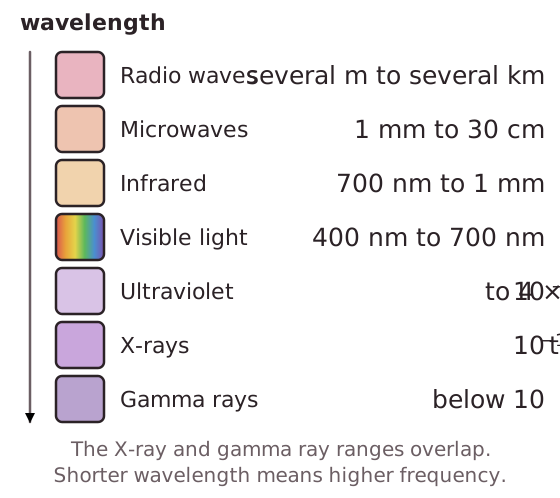
Radio waves have wavelengths of several metres to several kilometres. Microwaves have wavelengths of about 1mm to 30cm. Infra-red, visible (Red light 700nm) to violet light (400nm). Ultra-violet radiation has wavelengths from about 4 × 10
-7 m down to 10
-8 m. X-rays have wavelengths from about 10
-8 m to 10
-12 m and gamma rays about 10
-10 m and shorter, so the two ranges overlap. Gamma rays are emitted by radioactive substances because of their unstable nuclei. X-rays are made when fast-moving electrons collide with metal surfaces.c = f x λ. Like all waves EM waves can be reflected, refracted and diffracted.
Polarisation
Can electromagnetic waves be polarised? EM waves are transverse so can be polarised. Unpolarised EM waves oscillate in several random planes. If passed through a polarising filter (polariser) only waves that oscillate in a particular plane with a particular orientation will be allowed to pass through.
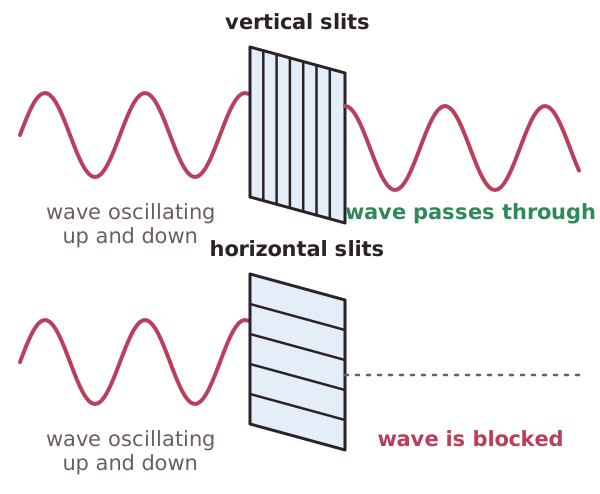
Polaroid filters are plastic films that contain very long, thin crystals.
Aerials
In order to reduce interference between nearby transmitters, neighbouring transmitters can broadcast with different planes of polarisation, for example one horizontal and one vertical. Aerials can be aligned to pick up signals with minimum interference.