Progressive waves are oscillations that travel through matter or space. They transfer energy from one place to another. Progressive waves can be transverse or longitudinal. With longitudinal waves, particles vibrate in a plane parallel to the direction of energy transfer.  The particles vibrate but do not move along the waves. Sound waves are progressive waves that arise because vibrations occur in a plane parallel to the direction of energy transfer.
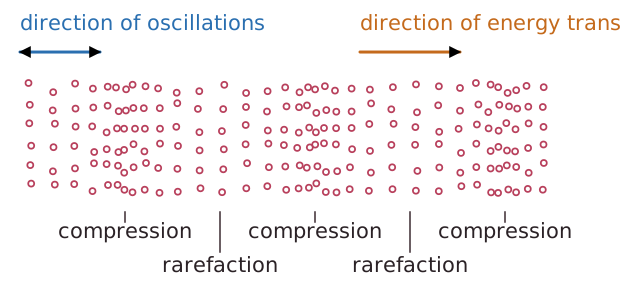 Air particles oscillate about an equilibrium position. The particles in the medium exert forces on neighbouring particles. So there is always a restoring force pulling the particle back to its equilibrium position. With transverse waves, the particles vibrate in a plane perpendicular to the direction of energy transfer.
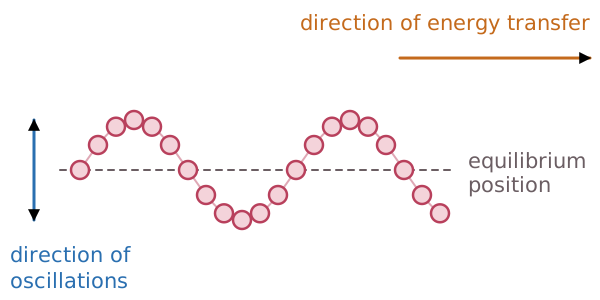 Earthquakes produce P-waves and S-waves. Both are progressive waves. P waves are longitudinal waves, S waves are transverse waves.
The particles vibrate but do not move along the waves. Sound waves are progressive waves that arise because vibrations occur in a plane parallel to the direction of energy transfer. Air particles oscillate about an equilibrium position. The particles in the medium exert forces on neighbouring particles. So there is always a restoring force pulling the particle back to its equilibrium position. With transverse waves, the particles vibrate in a plane perpendicular to the direction of energy transfer. Earthquakes produce P-waves and S-waves. Both are progressive waves. P waves are longitudinal waves, S waves are transverse waves.