Skip to content

Elastic Strain Energy

Work done = force × distance travelled in the direction of the force.To calculate the work done we use the average force ½F.ΔEel = ½ F Δ x
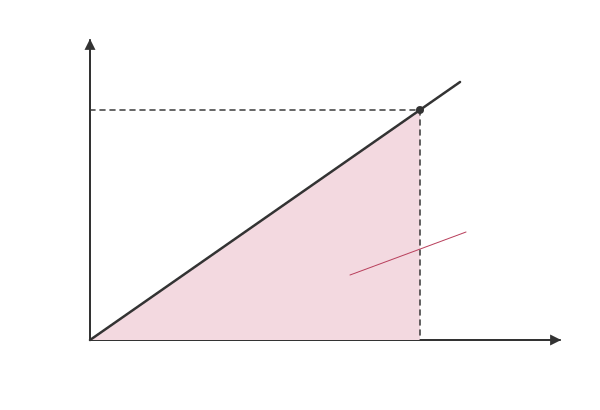
When a spring or wire is stretched, the work done on it is stored as elastic strain energy. If it obeys Hooke's law, the force rises steadily from 0 to F, so the average force is ½F and the work done is ½F multiplied by the extension Δx.This is the same as the area under the force-extension graph, which for the straight-line region is a triangle of base Δx and height F.Since F = kΔx, the energy can also be written
ΔEel = ½ k (Δx)2
so doubling the extension stores four times as much energy.Worked exampleA spring of stiffness 250 N m-1 is stretched by 0.080 m.Force: F = kΔx = 250 × 0.080 = 20 NEnergy stored: ΔEel = ½ × 20 × 0.080 = 0.80 JCheck: ½ × 250 × 0.0802 = 0.80 JIf a material is stretched beyond its limit of proportionality the graph is curved, so ½FΔx no longer applies and the energy is found by estimating the area under the curve, for example by counting squares. The stored energy is only fully recovered when the load is removed if the deformation was elastic.

Read the text

Read the text and highlight anything you think is important. When you go on, the text is hidden and you answer from memory.

Specification: Edexcel Physics (8PH0), AS-level, Topic 4: Materials, statements 55 and 58. Topic: Solid Materials.

Key terms in this lesson

force-extension graph
A graph of the applied force against the resulting extension of a sample, used to find its stiffness and the work done stretching it.

More in Solid Materials

All 14 lessons in Solid Materials · All Edexcel AS-level Physics topics