When two progressive waves pass through each other in opposite directions they superpose forming a stationary wave. A stationary wave is also called a standing wave.Stationary waves can be formed by using a string in tension with both ends fixed such as a guitar string. When the string is plucked gently, progressive waves travel towards each end and reflect at the ends then pass through each other.The middle part vibrates but the ends are fixed and cannot vibrate.The fundamental mode is the simplest stationary wave pattern on a string.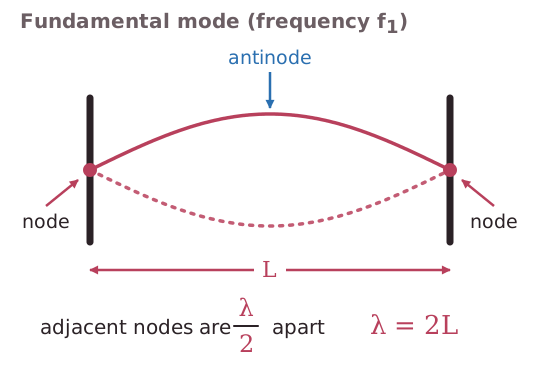 It consists of a single loop with nodes at each end and an antinode (a point of maximum amplitude) midway
It consists of a single loop with nodes at each end and an antinode (a point of maximum amplitude) midway| distance between adjacent nodes | = | 1λ 2 |
| λ | = | 2L |
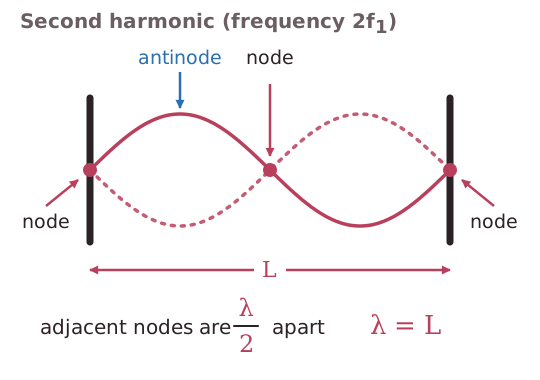
| distance between adjacent nodes | = | 1λ 2 |
| λ | = | L |