Skip to content

Explanation of Stationary Waves

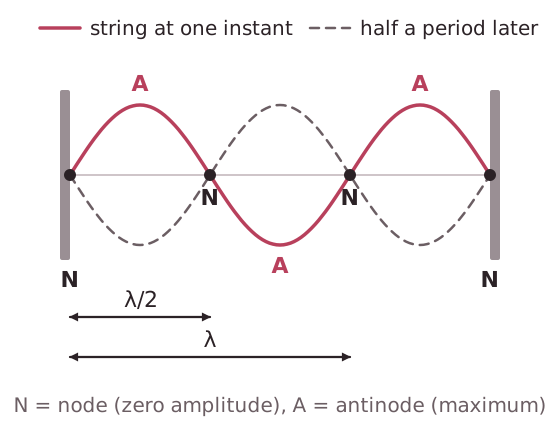
Stationary waves vibrate freely and do not transfer energy to their surroundings. The amplitude is zero at the nodes and maximum at the anti nodes. Because the nodes and antinodes are in fixed positions, no energy is transferred in a freely vibrating stationary wave.
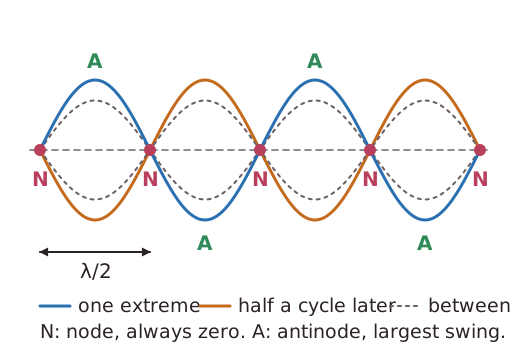
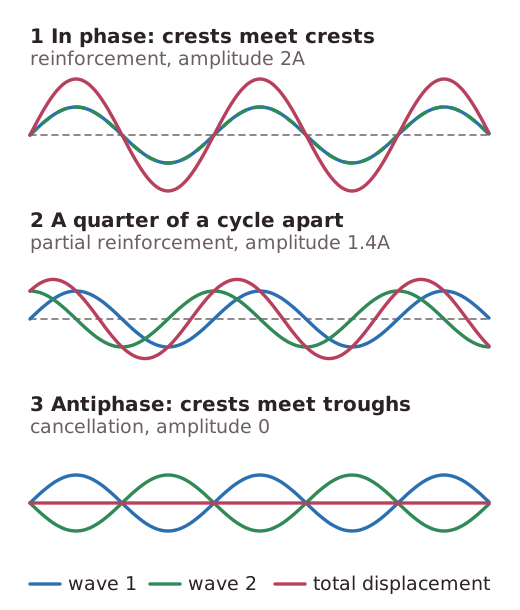
Two progressive waves passing through each other reinforce each other when in phaseA quarter of a cycle later both waves have moved ¼λ in opposite directions.They are now in antiphase so they cancel.A quarter of a cycle later they are back in phase so reinforcement takes place but it is reversed.
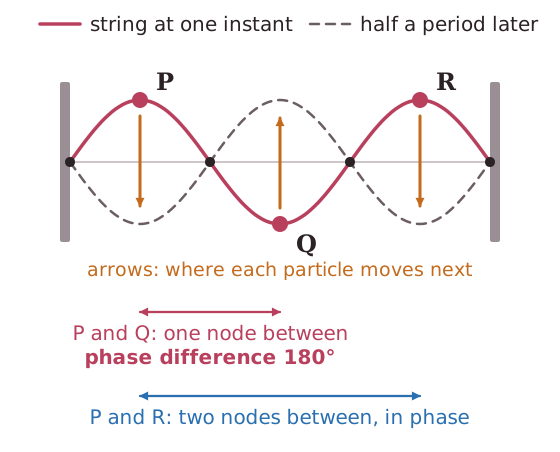
The points where there is no displacement are fixed throughout and the stationary wave oscillates between the nodes.The amplitude varies from zero at the nodes to a maximum at the antinodes. The phase difference is zero between adjacent nodes and 180° if the particles are separated by an odd number of nodes.
The crest reverses phase when it reflectsThe time taken for the vibrator to pass through a whole number of cycles:
t=m
f
where m is the number of cycles.Since time = distance/speed and the distance the first wave travels to the reflector and back is 2Lthe time t must equal a whole number of time periods mT or m/f, so:
2L
c
=m
f
Nodes: Fixed positions where there is no displacement.Antinodes: The points where there is maximum amplitude.Phase Difference: Zero if two particles are between adjacent nodes or separated by an even number of nodesThe phase difference is 180°(π radians) if the two particles are separated by an odd number of nodes.

Read the text

Read the text and highlight anything you think is important. When you go on, the text is hidden and you answer from memory.

Specification: AQA Physics (7407), AS-level, 3.3.1.3 Principle of superposition of waves and formation of stationary waves. Topic: Waves.

Key terms in this lesson

Photon
A discrete packet, or quantum, of electromagnetic energy.
Coherent
Waves are coherent if they have the same frequency and a constant phase difference.

More in Waves

All 24 lessons in Waves · All AQA AS-level Physics topics