 BRAINCAKE
Electron Excitation by Collisions
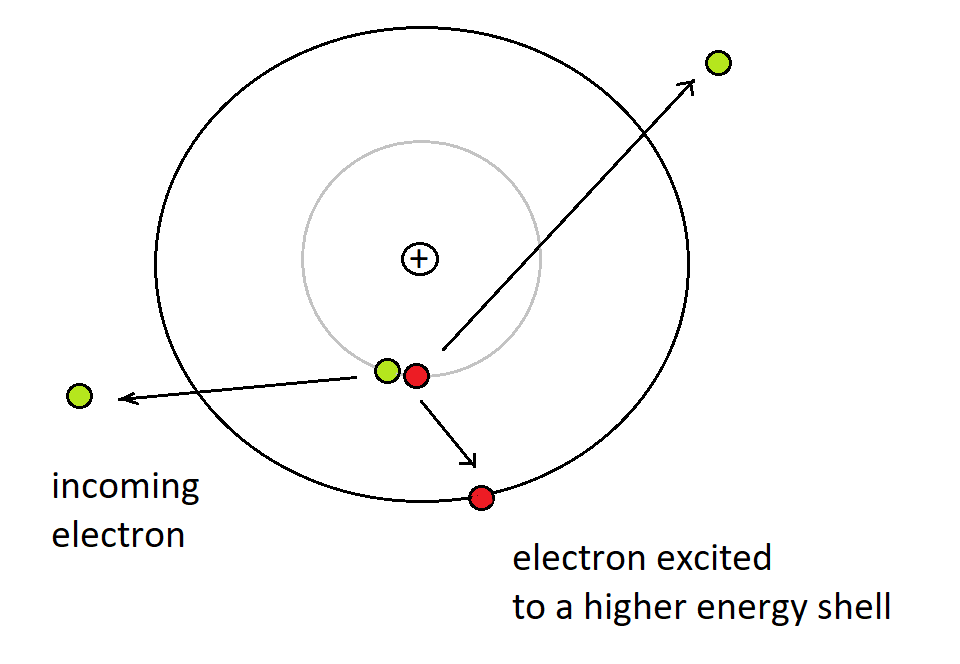
When gas particles collide with electrons if there is not enough energy for ionisation at certain energies excitation occurs.
If no excitation, then the particles are deflected with no loss of kinetic energy.
Sign in free to see the rest of this lesson, the R.E.C.I.P.E. recall steps and the quiz
BrainCake is free. Make an account in seconds and pick up where this page stops.
Key terms in this lesson
- Electron volt
- The energy transferred when an electron moves through a potential difference of one volt, equal to 1.6 times ten to the minus 19 joules.
- Photon
- A discrete packet, or quantum, of electromagnetic energy.
- Ionisation
- The removal of one or more electrons from a neutral atom, or the addition of electrons, to form an ion.
More in The Photoelectric Effect
- The Vacuum Photocell
- Ionisation
- Measuring Ionisation Energy
- Energy of Electrons
- Excitation Using Photons
- De-excitation
- Fluorescence
- Fluorescent Tube
All 19 lessons in The Photoelectric Effect · All AQA AS-level Physics topics