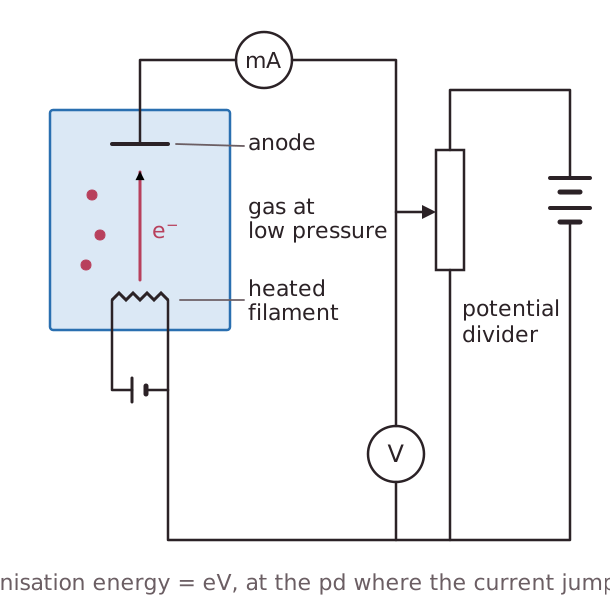
Electrons are emitted from a heated filament in a sealed tube and are attracted to a positive anode. Gas atoms in the sealed tube collide with electrons of increasing speed.The potential difference is increased to increase the speed of the electrons.No ionisation occurs until the electrons reach a certain speed/kinetic energy.Ionisation near the anode causes a much greater current to pass through the ammeter.The ionisation energy is equal to the work done on each electron which is equal to eV, the charge of the electron multiplied by the potential difference between the filament and anode.