If a photon with sufficient energy passes near a nucleus or an electron, it can suddenly change into a particle-antiparticle pair which would then separate from each other.The photon creates a particle and a corresponding antiparticle with a minimum energy given by:min Energy of photon
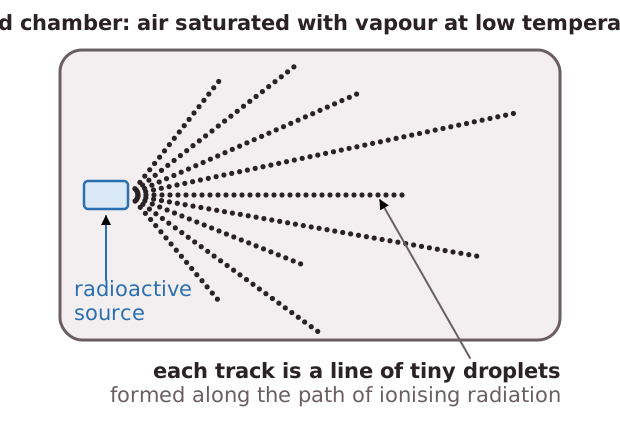
where E0 = rest energyThe electron has a rest energy of 0.511MeV therefore the photon needs an energy of at least 2 ×0.511MeV or 1.64×10⁻¹³J.A photon with less energy cannot create a positron-electron pair.A cloud chamber is a small transparent container which contains air saturated with vapour at a very low temperature.Ionising radiation leaves a visible trail of droplets.
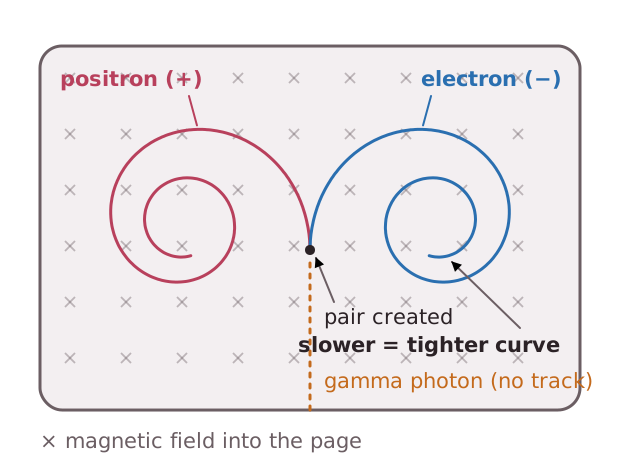
When a magnetic field is applied to a cloud chamber the particles are deflected. Positive particles are deflected in the opposite direction to negative particles.Slower particles bend more.
min Energy of photon
= h f min
= 2 E0
where E0 = rest energyThe electron has a rest energy of 0.511MeV therefore the photon needs an energy of at least 2 ×0.511MeV or 1.64×10⁻¹³J.A photon with less energy cannot create a positron-electron pair.A cloud chamber is a small transparent container which contains air saturated with vapour at a very low temperature.Ionising radiation leaves a visible trail of droplets.