 BRAINCAKE
The Weak Nuclear Force
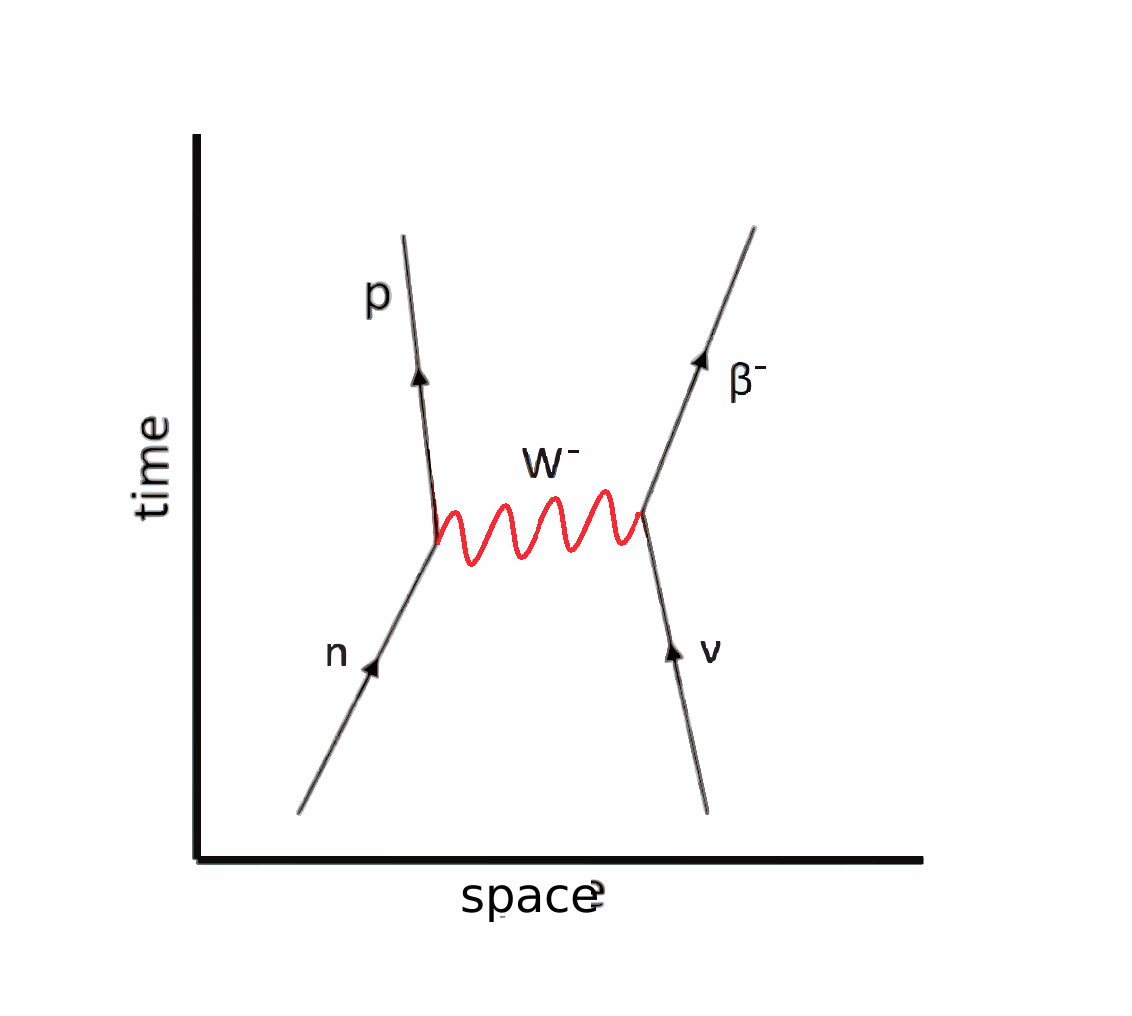
The weak nuclear force causes neutrons to change into protons in β-minus decay and causes protons to change into neutrons in β-plus decay.
It is weaker than the strong nuclear force so does not affect stable nuclei.
In beta decay a particle and an antiparticle are created.
Sign in free to see the rest of this lesson, the R.E.C.I.P.E. recall steps and the quiz
BrainCake is free. Make an account in seconds and pick up where this page stops.
Key terms in this lesson
- Strong nuclear force
- The short-range attractive force between nucleons that overcomes the electrostatic repulsion between protons and holds the nucleus together, becoming repulsive at very short separations.
- Beta particle
- A fast-moving electron (beta-minus) or positron (beta-plus) emitted from the nucleus when a neutron changes into a proton, or a proton changes into a neutron, during beta decay.
- Antiparticle
- A particle with the same rest mass as its corresponding particle but with opposite charge and opposite values of other quantum properties.
- Positron
- The antiparticle of the electron: it has the same mass as an electron but a positive charge.
- W boson
- The exchange particle for the weak interaction; it may be positively charged (W+) or negatively charged (W-) and, unlike the photon, has a non-zero rest mass.
More in Particles and Radiation
- Pair Production
- The Discovery of the Positron
- The Electromagnetic Force
- Feynman Diagrams
- The W Boson
- Beta Decay
- Electron Capture
- Force Carriers
All 22 lessons in Particles and Radiation · All AQA AS-level Physics topics