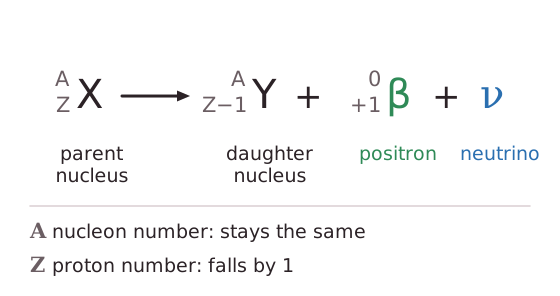
For every type of particle there is a corresponding anti-particle which has exactly the same rest mass as the particle but opposite charge.The antiparticle of the electron is the positron.Positron emitters are mostly made artificially, although a few natural isotopes (such as potassium-40) emit positrons.Positron emission takes place when a proton changes into a neutron in an unstable nucleus with too many protons. Some of the nuclei in the substance absorb the extra protons and become unstable positron emitters.
Anti-matter
Read the text
Read the text and highlight anything you think is important. When you go on, the text is hidden and you answer from memory.
Specification: AQA Physics (7407), AS-level, 3.2.1.3 Particles, antiparticles and photons. Topic: Particles and Radiation.
Key terms in this lesson
- Lepton
- A fundamental particle that does not interact through the strong interaction, for example the electron, the muon and their associated neutrinos.
- Hadron
- A particle made up of quarks that interacts through the strong interaction; hadrons are divided into baryons and mesons.
- Muon
- A negatively charged lepton, similar to but much heavier than the electron, produced for example by cosmic rays in the atmosphere.
- Neutrino
- An uncharged, almost massless lepton that interacts only very weakly with matter and is emitted, along with a beta particle, in beta decay.
More in Particles and Radiation
- Beta Radiation
- Gamma Radiation and Electromagnetic Waves
- The Electron Volt
- Photons
- Annihilation
- Pair Production
- The Discovery of the Positron
- The Electromagnetic Force
All 22 lessons in Particles and Radiation · All AQA AS-level Physics topics