Beta particles are fast-moving electrons or positrons from the nucleus.A β- particle is emitted from the nucleus when a neutron decays into a proton. Beta minus decay happens when there are too many neutrons.
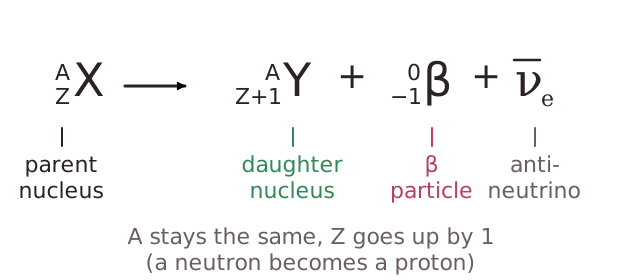
A β+ particle is the antiparticle of an electron and is emitted from the nucleus when a proton decays into a neutron.When an unstable element emits a beta minus particle the atomic number increases by one and the atom changes into a different element.
Beta Radiation
Read the text
Read the text and highlight anything you think is important. When you go on, the text is hidden and you answer from memory.
Specification: AQA Physics (7407), AS-level, 3.2.1.3 Particles, antiparticles and photons and 3.2.1.2 Stable and unstable nuclei. Topic: Particles and Radiation.
Key terms in this lesson
- Strong nuclear force
- The short-range attractive force between nucleons that overcomes the electrostatic repulsion between protons and holds the nucleus together, becoming repulsive at very short separations.
- Weak nuclear force
- The fundamental interaction responsible for beta decay, in which particles interact through the exchange of W bosons.
- Quark
- A fundamental particle that combines with other quarks to make up hadrons; at A-level, up, down and strange quarks are considered.
More in Particles and Radiation
- The Strong Nuclear Force
- Forces in the Nucleus
- Radioactive Decay
- Alpha Radiation
- Gamma Radiation and Electromagnetic Waves
- The Electron Volt
- Photons
- Anti-matter
All 22 lessons in Particles and Radiation · All AQA AS-level Physics topics