Stable nuclei do not disintegrate. The strong nuclear force holds the nucleons together. The strong nuclear force overcomes the electrostatic force of repulsion between the protons in the nucleus and keeps the neutrons and protons together.The range of the strong nuclear force is about the diameter of a small nucleus and acts equally between neutrons and protons.In comparison, the range of the electrostatic force is infinite and acts only on the protons.
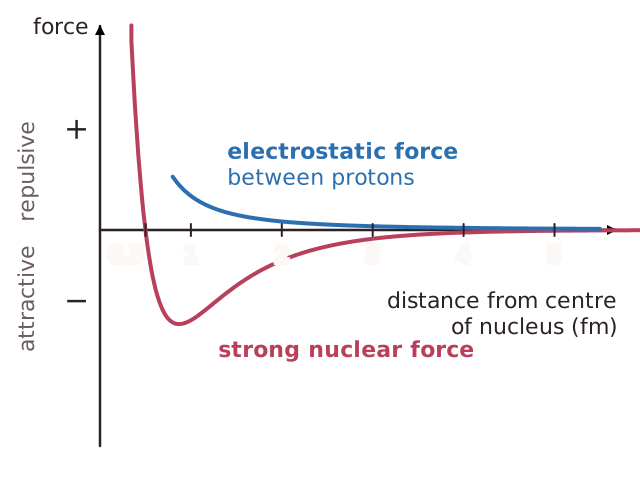
Forces in the Nucleus
Read the text
Read the text and highlight anything you think is important. When you go on, the text is hidden and you answer from memory.
Specification: AQA Physics (7407), AS-level, 3.2.1.2 Stable and unstable nuclei. Topic: Particles and Radiation.
Key terms in this lesson
- Antiparticle
- A particle with the same rest mass as its corresponding particle but with opposite charge and opposite values of other quantum properties.
- Hadron
- A particle made up of quarks that interacts through the strong interaction; hadrons are divided into baryons and mesons.
- Potential difference
- The energy transferred per unit charge as charge moves between two points in a circuit.
More in Particles and Radiation
- Structure of the Atom
- Isotopes
- Specific Charge
- The Strong Nuclear Force
- Radioactive Decay
- Alpha Radiation
- Beta Radiation
- Gamma Radiation and Electromagnetic Waves
All 22 lessons in Particles and Radiation · All AQA AS-level Physics topics