Skip to content

Motion of a Powered Vehicle

Air resistance increases with speed. Top Speed is reached by vehicles when the driving force is equal to the air resistance.
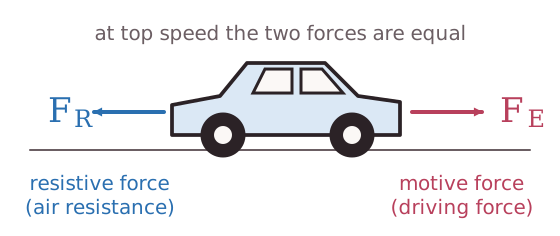
Initially drag is zero and a = ΣF/mDrag increases with speedSo at terminal speed FR = FE and acceleration is zeroThe engine provides a driving force FE forwards. The resistive forces FR (air resistance and friction) act backwards. By Newton's second law:
FE - FR = ma
When the vehicle starts from rest, the resistive force is small, so the acceleration is large. As the speed increases, the air resistance increases, so the resultant force and the acceleration decrease. The vehicle reaches its top speed when FR = FE and the resultant force is zero.A vehicle's top speed can be increased by a larger driving force or by a more streamlined shape, which reduces air resistance at any given speed.When a vehicle tows a trailer, treat the vehicle and trailer as one object to find the acceleration. Then apply F = ma to the trailer alone to find the force in the tow bar or rope.

Read the text

Read the text and highlight anything you think is important. When you go on, the text is hidden and you answer from memory.

Specification: AQA Physics (7407), AS-level, 3.4.1.5 Newton's laws of motion. Topic: Newtons Laws of Motion.

Key terms in this lesson

Momentum
The product of an object's mass and its velocity; a vector quantity, conserved in any interaction provided no external resultant force acts.

More in Newtons Laws of Motion

All 16 lessons in Newtons Laws of Motion · All AQA AS-level Physics topics