 BRAINCAKE
Resultant Forces
The resultant force on an object is the single force that has the same effect as all the forces acting on it together. It is the vector sum of the forces, and by Newton's second law it equals mass × acceleration: F1 + F2 + ... = ma.
To use this, choose a positive direction, add the forces in that direction and subtract those in the opposite direction. The result divided by the mass gives the acceleration.
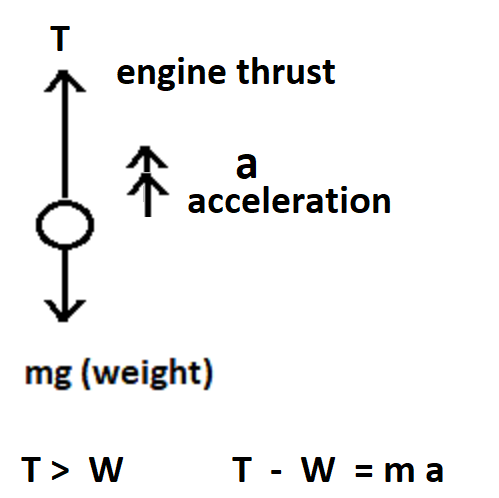
For a rocket rising vertically, the resultant force is the thrust T minus the weight mg, so T - mg = ma.
Sign in free to see the rest of this lesson, the R.E.C.I.P.E. recall steps and the quiz
BrainCake is free. Make an account in seconds and pick up where this page stops.
More in Newtons Laws of Motion
- Newton's First Law of Motion
- Investigating Force and Motion
- Newton's Second Law of Motion
- Weight
- Sliding Down a Slope
- Object Falling in a Fluid
- Terminal Speed
- Motion of a Powered Vehicle
All 16 lessons in Newtons Laws of Motion · All AQA AS-level Physics topics