Skip to content

Non-uniform Acceleration

Acceleration is the rate of change of velocity, a = Δv/Δt. With non-uniform acceleration the acceleration itself changes with time, so the velocity-time graph is a curve rather than a straight line.The acceleration at any instant is the gradient of the tangent to the velocity-time graph at that time. Draw the tangent, then divide the change in velocity by the change in time along it.
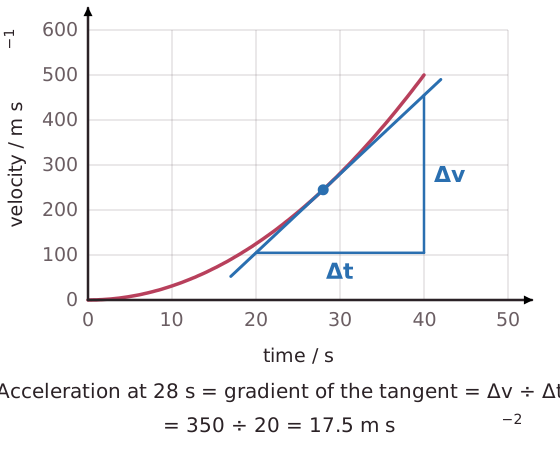
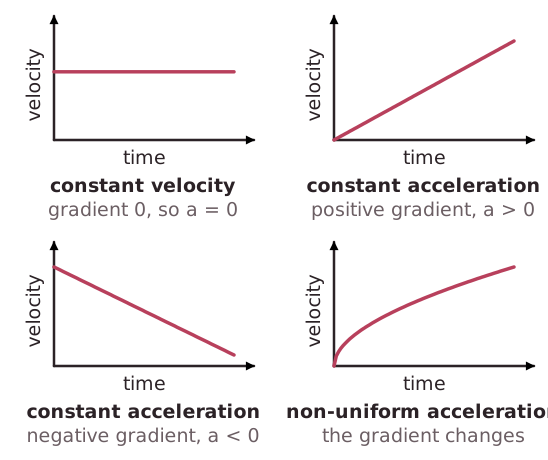
If the curve becomes steeper with time, the acceleration is increasing. If it becomes less steep, the acceleration is decreasing, as happens when an object falling through air approaches its terminal velocity.The displacement is still given by the area under the velocity-time graph, even when the line is curved. The area can be estimated by counting squares or by splitting it into strips.
Non-uniform acceleration can also be shown on an acceleration-time graph, where each value is the gradient of the velocity-time graph at that time. The equations for constant acceleration cannot be used when the acceleration is non-uniform.

Read the text

Read the text and highlight anything you think is important. When you go on, the text is hidden and you answer from memory.