Skip to content

Displacement-time Graphs

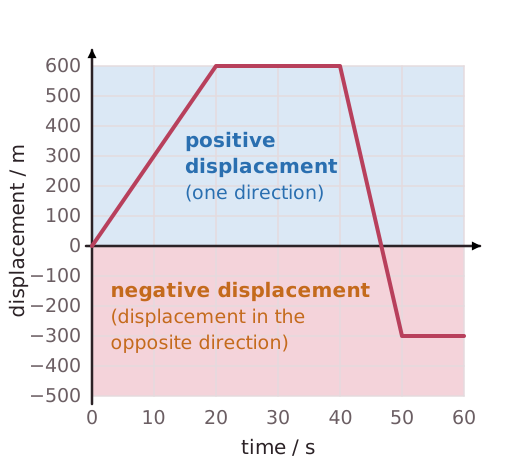
A displacement-time graph shows the position of an object relative to its starting point as time passes. Displacement is a vector, so the graph can go below the time axis.
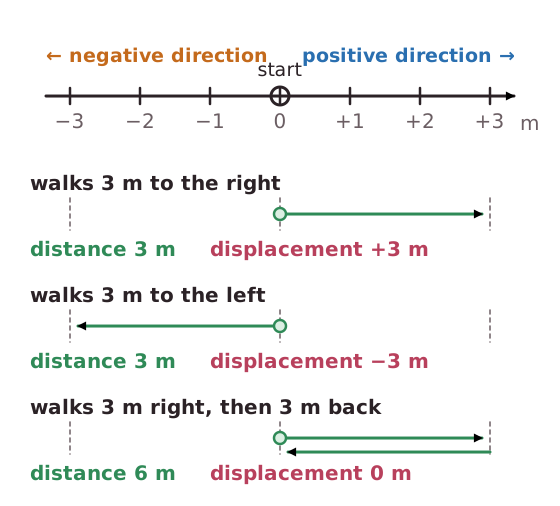
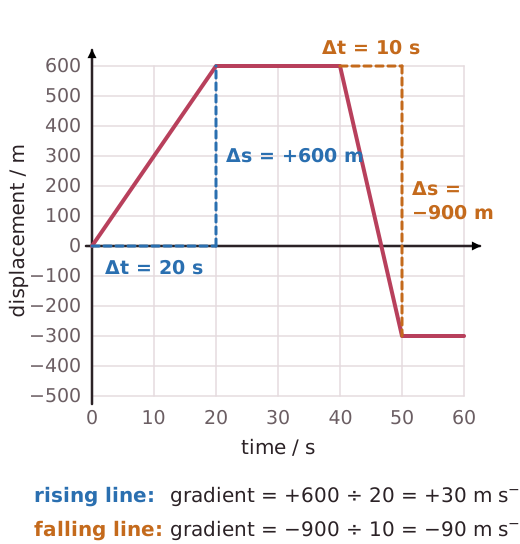
The gradient of a displacement-time graph is the velocity. A positive gradient means the object is moving in the positive direction, and a negative gradient means it is moving in the opposite direction.
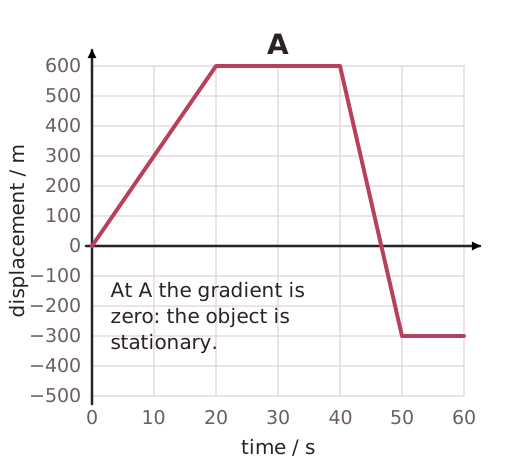
Values below the time axis show that the object is on the other side of its starting point. A horizontal line means the object is stationary, and a curve means its velocity is changing. The instantaneous velocity is the gradient of the tangent at that time.
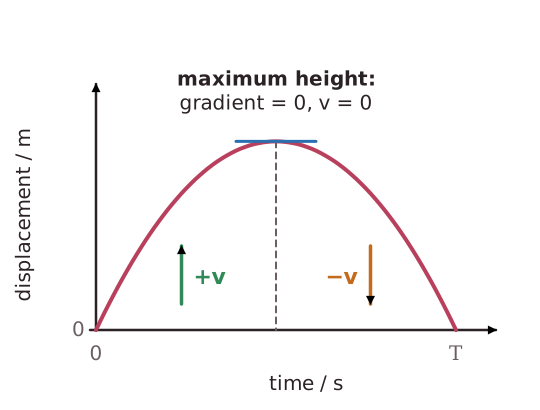
For a ball thrown straight up, the displacement rises to a maximum and then falls back to zero as the ball returns. At the top the gradient, and so the velocity, is zero. The curve is steepest when the ball leaves and returns to the hand.

Read the text

Read the text and highlight anything you think is important. When you go on, the text is hidden and you answer from memory.

Specification: AQA Physics (7407), AS-level, 3.4.1.3 Motion along a straight line. Topic: Motion.

Key terms in this lesson

gravitational field strength
The gravitational force per unit mass acting on an object at a point in a gravitational field, given the symbol g.

More in Motion

All 17 lessons in Motion · All AQA AS-level Physics topics