Final velocity = initial velocity + additional velocity due to acceleration
v = u + a t
so
v2 = u2 + 2as
displacement = average velocity × time.
s = ½(u + v) t
s = ut + ½at2
and
s = vt - ½at2
These equations (often called the suvat equations) only apply when the acceleration is constant. The symbols are: s displacement, u initial velocity, v final velocity, a acceleration and t time.
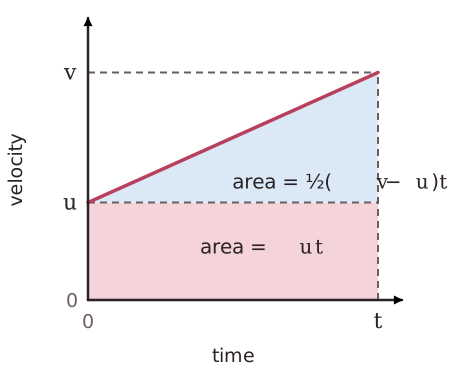
They come from the velocity-time graph. The acceleration is the gradient, a = (v - u)/t, which rearranges to v = u + at. The displacement is the area under the graph, which is a trapezium, giving s = ½(u + v)t.
Each equation links four of the five quantities. To solve a problem, write down the three you know and choose the equation that does not contain the quantity you are not interested in.
For example, a ball rolls from rest down a 24 m ramp in 8.0 s. We know s = 24 m, u = 0 and t = 8.0 s, and v is not needed, so we use s = ut + ½at
2:
24 = ½ × a × 8.02 so a = 0.75 m s-2Choose one direction as positive and give vectors pointing the other way a negative sign.