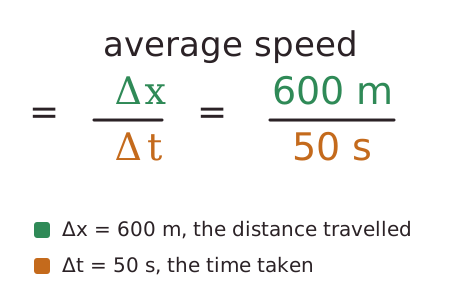
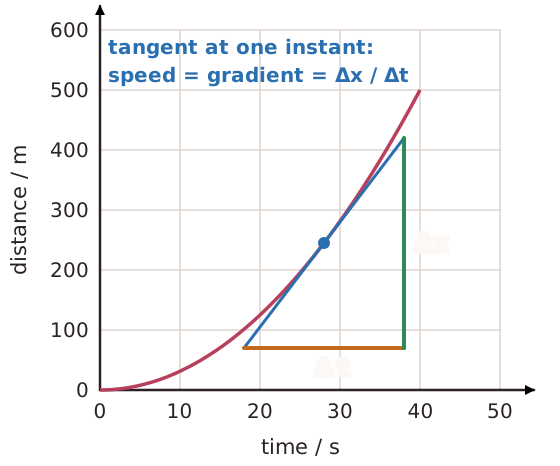
A distance-time graph shows how far an object has travelled as time passes. The gradient of the graph is the speed of the object.
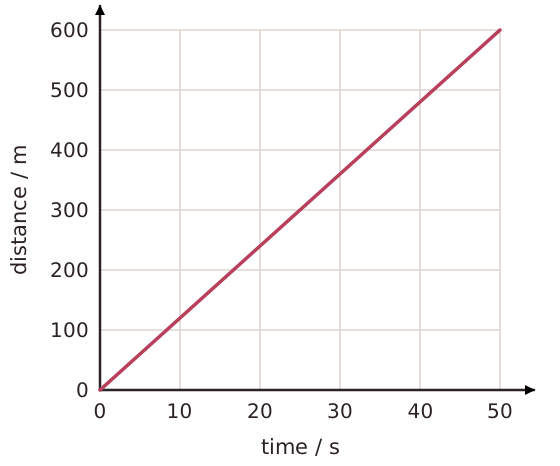
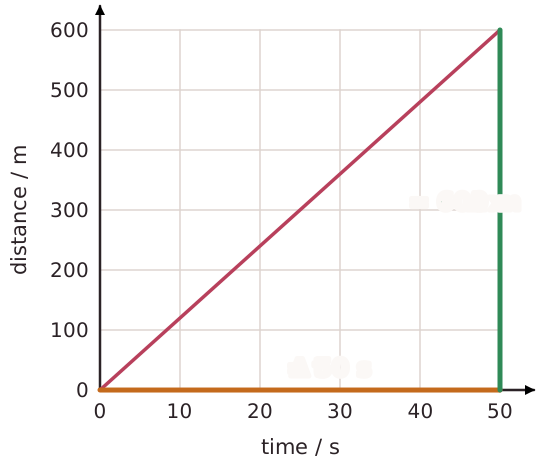
A straight sloping line has a constant gradient, so the object is moving at constant speed. A steeper line means a greater speed.
A horizontal line has zero gradient, so the object is stationary. Distance travelled never decreases, so a graph of distance travelled against time can never slope downwards. A graph of distance from a fixed point, such as home, can slope downwards when the object moves back towards that point.
A curved line shows that the speed is changing. If the curve gets steeper the object is speeding up, and if it gets less steep the object is slowing down. The instantaneous speed at any moment is the gradient of the tangent to the curve at that time, while the average speed is the total distance divided by the total time.
Distance-time Graphs
Read the text
Read the text and highlight anything you think is important. When you go on, the text is hidden and you answer from memory.
Specification: AQA Physics (7407), AS-level, 3.4.1.3 Motion along a straight line. Topic: Motion.