When two springs are placed in series the total extension is the sum of the individual extensions of each spring.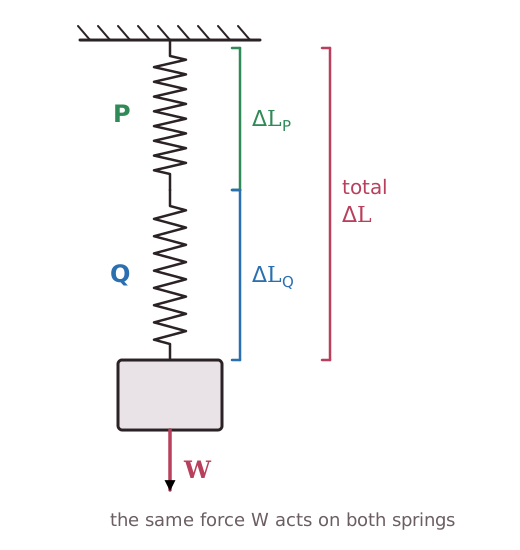
Effective spring constant
k = kPkQ / (kP + kQ) Two identical springs in series give half the stiffness of one spring, so the extension is doubled. Springs in series are always less stiff than either spring on its own.Worked example: springs of 2000 N m-1 and 2500 N m-1 in series carry a load of 1850 N. The extensions are 1850/2000 = 0.925 m and 1850/2500 = 0.740 m, giving a total of 1.665 m. Check: k = (2000 × 2500)/4500 = 1111 N m-1, and 1850/1111 = 1.665 m.
| ΔLP | = | W kP |
| ΔLQ | = | W kQ |
| ΔLP + ΔLQ | = | W kP | + | W kQ |
Effective spring constant
| 1 k | = | 1 kP | + | 1 kQ |